
Overview
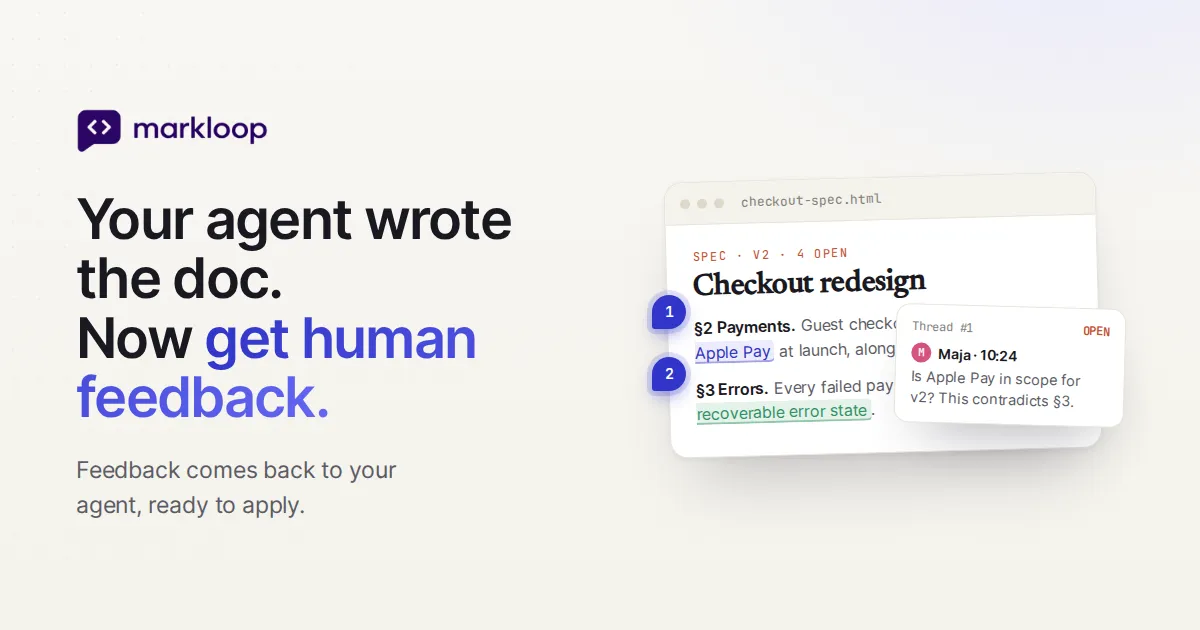
Markloop is a web application designed to close the feedback loop between AI coding agents and human reviewers. It accepts HTML documents produced by agents—such as specs, reports, and proposals—and provides a structured environment for reviewers to leave anchored comments and answer embedded questions. The feedback is then packaged into a machine-readable format that agents can consume directly via MCP or as plain files, eliminating manual copy-pasting.
Key Features
-
Anchored Comments: Reviewers can pin comments to specific sections or sentences within the document. Comments remain attached to the exact version they were made on, preserving context across revisions.
-
Agent-Ready Export: Every comment is exported with its CSS selector, quoted text, reviewer intent, surrounding context, and version number. This structured package can be pulled by agents over MCP or read as a plain markdown file.
-
MCP Integration: Native support for Claude Code and Codex via the Model Context Protocol. Agents can push new versions and pull feedback without leaving the terminal.
-
Version Tracking: Each upload creates a new version in a chain. Comments are tied to their version, and resolved status is tracked across revisions.
-
Unlimited Reviewers: Reviewers are always free. They see only the rendered document, not the source HTML, and cannot edit or access other projects.
-
Share Controls: Invite viewers to a project for collaborative review, or share a single file via a read-only link with optional expiry and version visibility settings.
Use Cases
- Product Managers: Share PRDs and specs drafted by agents, collect stakeholder sign-off, and feed comments back into the next iteration.
- Engineers: Review RFCs, architecture docs, and migration plans with comments anchored to exact code blocks or diagrams.
- Consultants & Agencies: Deliver polished HTML reports and proposals to clients, who can comment and answer embedded questions without needing an agent setup.
- Anyone with an AI Agent: Any agent-generated HTML document—research, strategy, analysis—can be reviewed and looped back into the agent's workflow.