Iron Gorilla is an AI agent governance platform that uses behavioral trust scores to safely deploy autonomous agents in regulated industries.
Submit your website to get discovered by thousands of potential customers and boost your SEO.
Get ListedIron Gorilla is an enterprise platform designed to govern and deploy AI agents with a focus on safety, compliance, and trust. Founded by Jacob Hartmann and R.A. Reaves, the company targets regulated industries such as banking, healthcare, insurance, and defense, where autonomous AI actions must be tightly controlled. The core innovation is a behavioral trust score that measures each agent's performance over time, allowing organizations to gradually increase autonomy as agents prove themselves. This approach addresses a critical gap in the AI agent market: most tools focus on building agents but not on governing them in production. Iron Gorilla positions itself as the enforcement layer that sits between AI models and business operations, providing real-time guardrails, audit trails, and policy controls. The platform is built for teams that want to automate complex workflows without sacrificing compliance or security.
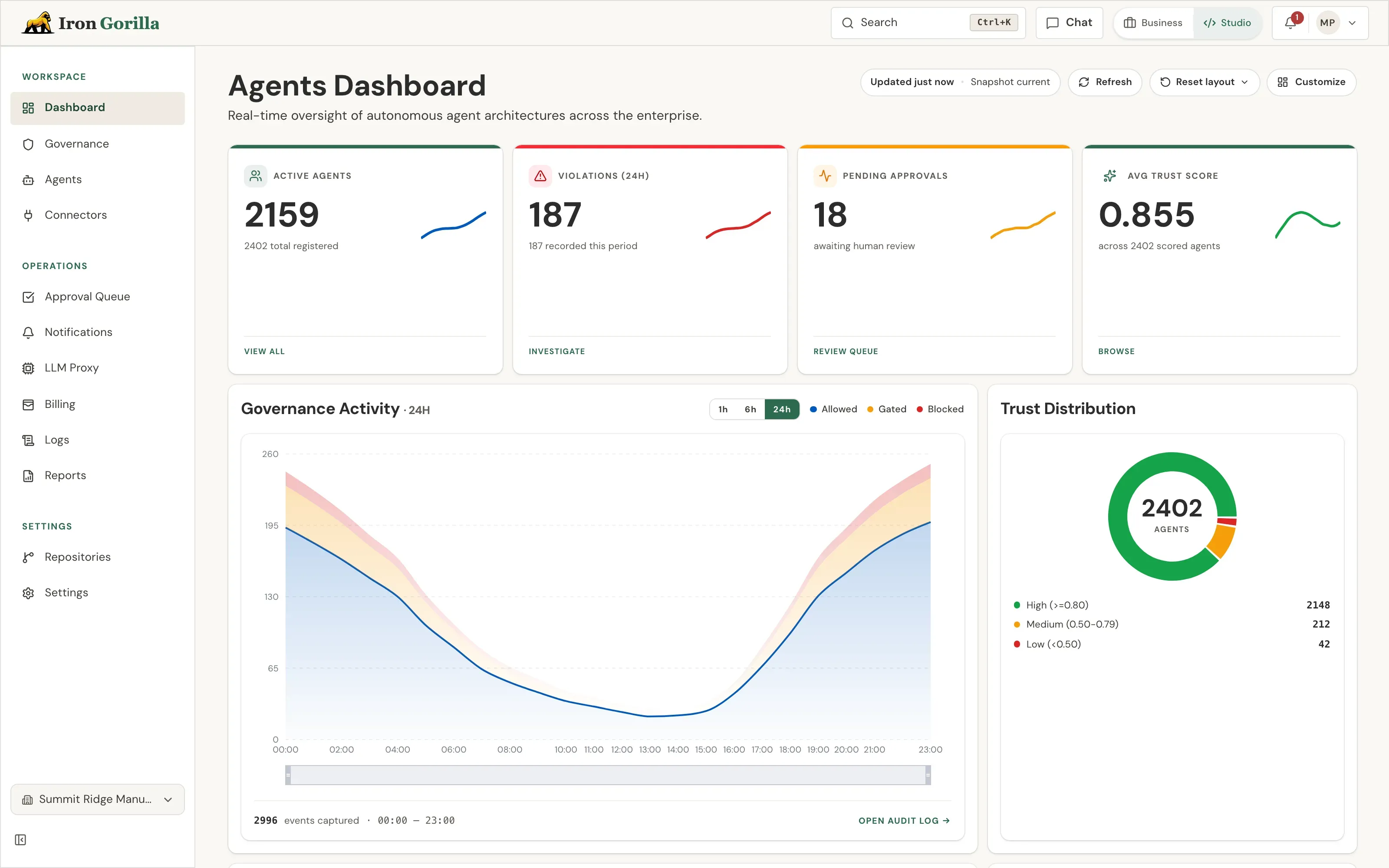
Behavioral Trust Score – Each agent is assigned a dynamic trust score based on its actions. The score increases when agents follow approved steps and decreases when they deviate or behave anomalously. This score determines the level of autonomy an agent can exercise, from fully supervised to fully autonomous. The system uses this score to automatically adjust permissions without human intervention.
Policy Builder – Organizations can define business rules and compliance requirements as live controls. Policies are written in natural language or structured formats and are enforced in real time on every agent action. This ensures that agents never violate regulatory or operational boundaries, even as they operate autonomously.
Agent Builder – Iron Gorilla provides a framework to move from business intent to launch-ready agents. Users can define agent roles, tools, and constraints without deep technical expertise. The builder integrates with the trust score system to ensure new agents start in supervised mode.
Operations Command Center – A centralized dashboard for approvals, signals, and evidence. Teams can review agent actions, approve or reject requests, and investigate incidents. The command center provides a single pane of glass for managing all agents across the organization.
Connectors and MCP – The platform supports integrations with existing tools via connectors and the Model Context Protocol (MCP). Each connection is scoped with specific permissions and health monitoring, ensuring agents only access what they need.
LLM Proxy – All model calls are routed through Iron Gorilla's proxy, which adds cost tracking, logging, and policy enforcement. This gives organizations visibility into which models are used, how much they cost, and whether they comply with internal policies.
Reporting and Compliance – The platform generates audit-ready reports and exports for regulatory compliance. It maps to frameworks like HIPAA, CMMC, SOX, and FedRAMP, providing evidence that agents operated within approved boundaries.
Organizations start by defining the job they want to automate, such as claims processing or customer triage. Iron Gorilla's agent builder helps create an agent with specific tools, data access, and behavioral policies. The agent begins in a supervised mode, where every action requires human approval. As the agent completes tasks correctly, its trust score increases, and it gains more autonomy. The system continuously monitors for anomalies, such as unusual activity patterns or policy violations, and can automatically revert the agent to supervised mode if needed. Teams can review all actions in the command center and adjust policies on the fly. Over time, proven agents can run entire workflows without human oversight, while the platform maintains a complete audit trail.
Banking Fraud Detection – A fraud analyst agent monitors transactions in real time. It flags suspicious activity and, if its trust score is high, can block transactions automatically. All decisions are logged for compliance with BSA/AML regulations.
Healthcare Triage – A triage coordinator agent processes patient intake emails. It categorizes requests, routes urgent cases to clinicians, and schedules appointments. The agent never accesses PHI beyond its scope, and every action is recorded for HIPAA audits.
Insurance Claims Processing – A claim processor agent handles routine claims, verifying policy details and approving payouts under a certain threshold. Exceptions are routed to human adjusters. The agent's trust score determines whether it can approve claims without review.
Defense Intelligence Summarization – A threat intelligence analyst agent ingests classified reports and produces summaries. It operates under strict CMMC and ITAR controls, with cryptographic chain-of-custody for every action.
Construction Change Order Management – A change order analyst agent reviews contractor requests, checks budgets, and routes approvals. It ensures no change order moves without the correct authorization path, reducing delays and compliance risks.
Iron Gorilla does not publicly list pricing on its website, but it offers a free trial and enterprise contracts. The platform is positioned for mid-market to large enterprises, particularly in regulated industries. Pricing likely scales with the number of agents, actions, and integrations. Given the complexity of the platform and its focus on compliance, the value proposition is strong for organizations that need to automate sensitive workflows without risking regulatory penalties. The behavioral trust score model reduces the need for constant human oversight, potentially lowering operational costs over time. However, smaller teams or startups may find the platform's capabilities beyond their needs or budget.
Iron Gorilla addresses a real and growing need: how to trust AI agents with real work in regulated environments. Its behavioral trust score is a novel approach that balances automation with safety. The platform's deep integration with compliance frameworks and its emphasis on real-time governance set it apart from simpler agent builders. However, the lack of transparent pricing and the enterprise focus may limit adoption among smaller teams. The platform is best suited for organizations that already have mature compliance processes and are looking to scale AI automation safely. For those teams, Iron Gorilla offers a robust, accountable foundation. Areas for improvement include more self-service onboarding and clearer documentation for non-enterprise users. Overall, Iron Gorilla is a promising solution for mission-critical AI deployment.