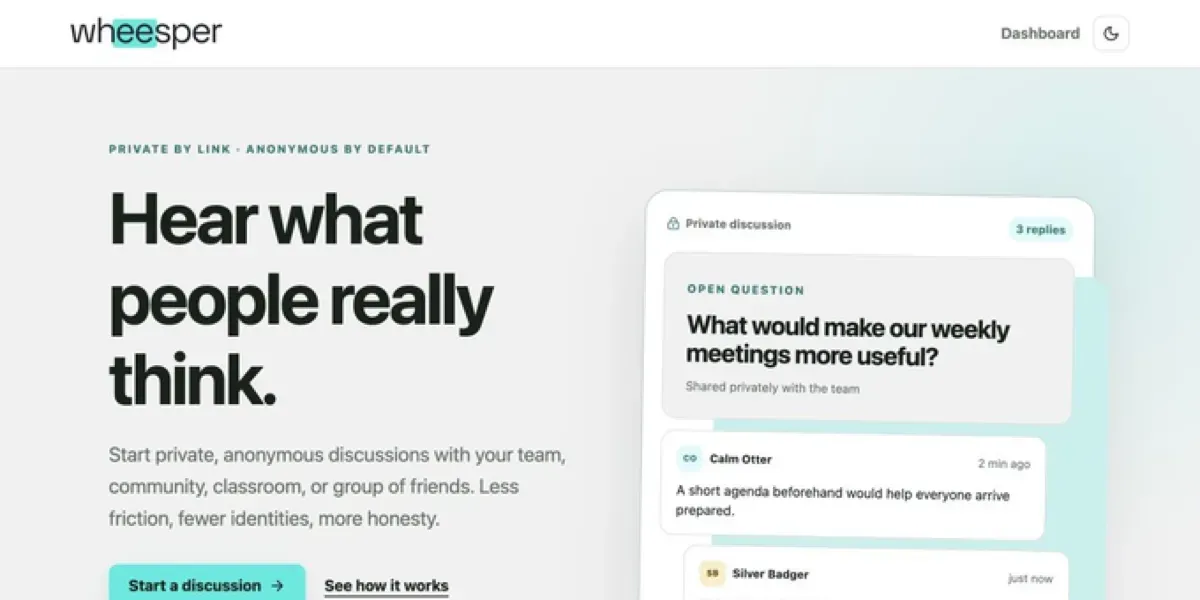
Wheesper creates isolated, private discussions with fresh pseudonyms per thread, enabling honest feedback without accounts or public profiles.
Revenue analytics for SaaS founders. See what actually drives your growth.
Submit your website to get discovered by thousands of potential customers and boost your SEO.
Get ListedWheesper is a private anonymous discussion platform designed to solve a common problem: people often hold back their true opinions when their identity is attached. By generating a new pseudonym for each thread and keeping conversations behind unguessable links, Wheesper enables candid feedback in teams, classrooms, communities, and personal circles. The platform requires no accounts or login, reducing friction and ensuring total anonymity. This review examines the technical implementation, practical use cases, and overall value of Wheesper for organizations and individuals seeking honest input.
Wheesper's core concept is simple: a discussion is created via a link that is shared privately. Participants click the link, are assigned a random pseudonym (e.g., "BlueFalcon42"), and can post replies in a threaded format. Each discussion is completely isolated—no public feed, no search engine indexing, and no way to link pseudonyms across different threads. This design removes the fear of judgment based on past comments, making it particularly valuable for topics where hierarchy or social pressure stifles honesty.
Wheesper stands out with a focused set of features that prioritize privacy and ease of use:
The workflow from creation to participation is streamlined:
Wheesper's simplicity is its strength. There is no onboarding, no profile setup, and no learning curve. The entire experience is designed to be as frictionless as possible, encouraging participation from those who might otherwise stay silent.
Wheesper targets scenarios where anonymity unlocks honest feedback:
These use cases share a common thread: the need for honest input when the default social dynamic discourages it. Wheesper provides a technical solution—anonymity by design—rather than relying on trust or culture.
Wheesper does not explicitly state pricing on its homepage. The platform appears to be free to use, as there are no mentions of subscription plans or premium features. This aligns with its minimalist approach: no accounts, no billing, no lock-in. The value proposition is zero-friction anonymity. However, the lack of a pricing page or business model raises questions about long-term sustainability. For now, users can create unlimited discussions at no cost, making it an attractive option for ad-hoc needs. Organizations considering regular use may want to check the privacy policy for data handling details.
Wheesper excels at what it sets out to do: provide a simple, secure space for anonymous discussions. The technical implementation—unguessable links, fresh pseudonyms, no accounts—is effective and user-friendly. It is particularly valuable for teams, educators, and community leaders who need honest feedback but lack the infrastructure for truly anonymous input. The main trade-offs are the lack of persistent identity (meaning no reputation or history across discussions) and reliance on the link for access (if lost, the discussion is gone). Moderation tools are also minimal compared to full-featured forums.
For its intended purpose, Wheesper is a solid, no-nonsense tool. It is best suited for short-term, focused discussions rather than ongoing community platforms. The straightforward design and zero cost make it a worthwhile trial for anyone needing candid responses. To start an anonymous discussion, use the start a discussion page.