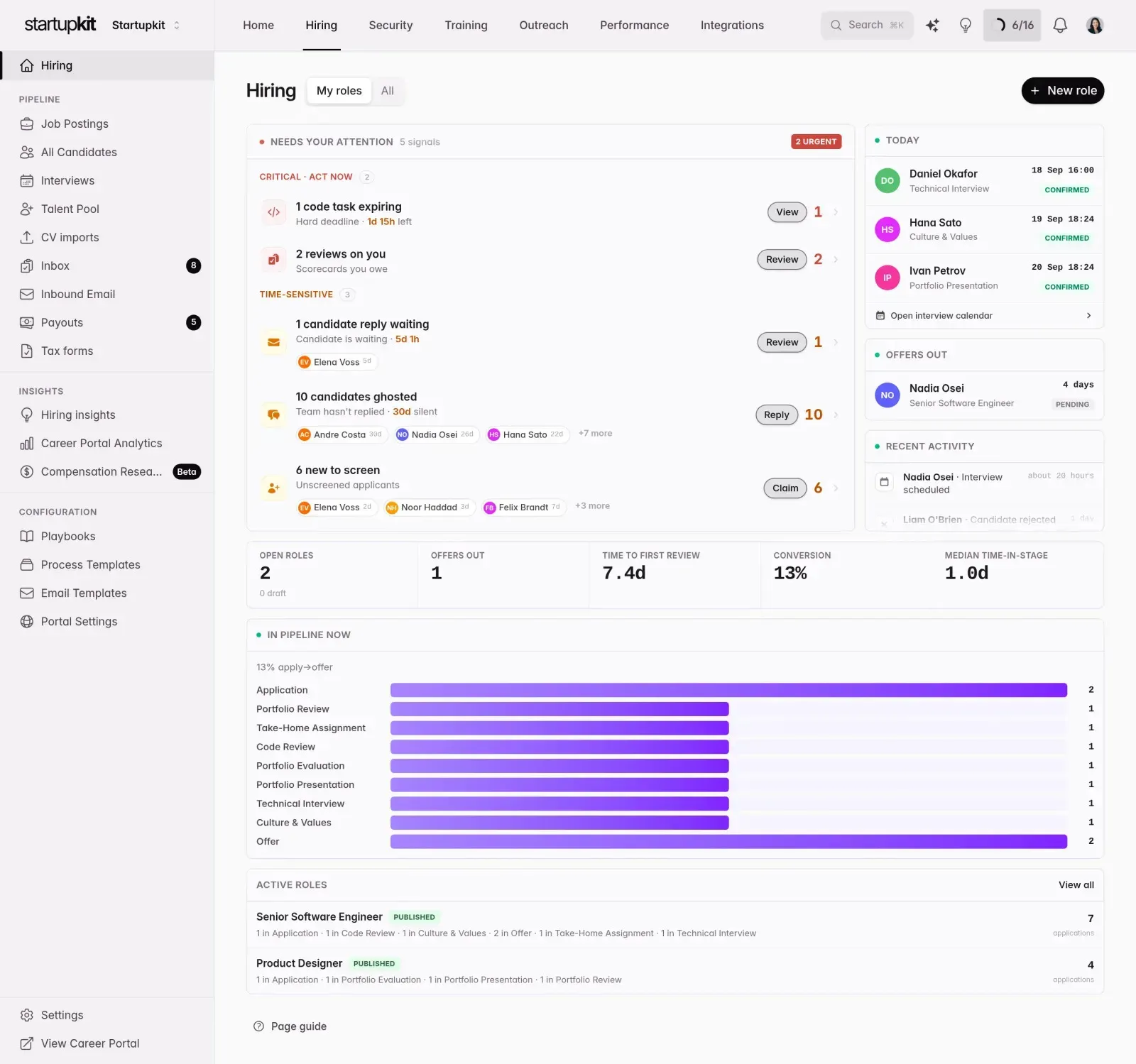
StartupKit's Kit folds recruiting pipelines, vulnerability disclosure, compliance training and approval-gated outreach into one per-seat account, with 190+ MCP tools so Claude, ChatGPT or Cursor can act on the same records.
Revenue analytics for SaaS founders. See what actually drives your growth.
Submit your website to get discovered by thousands of potential customers and boost your SEO.
Get ListedKit, the flagship product from StartupKit, collapses four internal operations — recruiting, vulnerability disclosure, compliance training and cold outreach — into one per-seat account. Its defining architectural choice is that external participants never create accounts: candidates, security researchers and trainees each receive a private magic link to a portal served on the company's own domain. Internal work happens in the browser or through an MCP connection exposing more than 190 tools to assistants such as Claude Code, ChatGPT and Cursor. Pricing starts at €6,99 per seat per month after a 30-day trial.
Four products, one login. StartupKit splits its surface area into hiring, security, training and outreach, with Compensation Research (beta) included in the base plan. The proposition is not that each module outclasses a dedicated specialist, but that the records live in the same account — so a candidate rejected during Q2 sourcing can later be cross-checked against an outreach campaign without exporting anything.
Onboarding begins with a signup that requires a card, though the 30-day trial is not charged. Teams then either build stages manually or copy a role template and edit it for their own process. Candidates, researchers and trainees operate entirely through magic links: no passwords, no separate portals to provision, and the portal sits on the company's own domain.
The second working surface is the assistant. A copyable prompt at startupkit.app/agent-setup/prompt.md instructs an agent to fetch and execute setup instructions, and the public MCP server functions before signup. Access is scoped with tokens tied to Kit permissions and can be revoked at any time. Because tool annotations distinguish read-only, destructive and outbound-contact operations, the client decides whether to pause for confirmation — a sensible design that nonetheless leaves final confirmation behaviour dependent on the assistant in use.
The operator/participant/agent framing explains the model clearly: an operator sees everything waiting on a response, a participant sees only their own record, and an agent sees the same state machine through tool calls. Each action that leaves the company's perimeter is labelled as such before execution.
The pricing page lists €6,99 per seat per month, with switching to $8, 29,99 zł or £5.99. Seats can be added or removed and the bill adjusts automatically. The 30-day trial requires a card but is never charged during the trial period; cancelling before day 30 avoids billing. Outreach is the only separately billed add-on at €17,99 per month, while Compensation Research (beta), interview scheduling and the complete security workflow are included. No dedicated startup discount exists — the published seat price applies to every team. Customer data is stored on EU infrastructure with a DPA available to all customers, though connected AI providers operate under their own processing terms.
Value depends on substitution. A team replacing a recruiting subscription, an interview scheduling add-on and a bug bounty platform with one account is comparing €6,99 per seat against several separate line items. Teams needing only one of the four modules will extract less leverage from the bundle.
StartupKit is an opinionated consolidation play: fewer tools, shared records, passwordless portals for outsiders and an agent layer carrying explicit safety annotations. It is strongest for small technical teams that hire regularly, run some form of disclosure programme and need training evidence for audits — the three concerns genuinely share data here rather than merely sharing a login screen.
The trade-offs are tangible. A card is required up front. Outreach costs extra and prospects interact only through email. Confirmation prompts for destructive agent calls depend on the MCP client, so guardrails are advisory rather than enforced. Data residency is EU-only, which rules the product out for teams with conflicting regional requirements. For its intended audience — startups shipping fast and preparing for a first audit — the bundle is coherent, transparently priced and defensible.