CiteTrue verifies APA, MLA, and Chicago reference lists against Crossref, PubMed, OpenAlex, arXiv and a dozen other academic indexes, scoring each entry field by field to expose fabricated titles, mismatched authors, drifted years, and invented DOIs before a reviewer finds them.
AI-powered SEO content on autopilot. Use code ALTERNATIVETOOLS for 10% off.
Submit your website to get discovered by thousands of potential customers and boost your SEO.
Get ListedFabricated references are one of the quietest failure modes in modern academic publishing. A large language model can produce a citation that looks immaculate — correct-sounding journal, plausible author list, realistic DOI — while pointing at a paper that never existed. CiteTrue is a free, AI-powered citation checker built to catch precisely that class of error before a reviewer, an editor, or an examination committee does. The tool cross-references each reference against more than a dozen authoritative academic databases and returns a per-entry confidence score, flagging anything that appears invented, mismatched, or AI-hallucinated.
Multi-database cross-verification. Every reference is resolved against a broad catalogue of indexed sources rather than a single index. The published source list includes arXiv, CORE, Crossref, Google Scholar, OpenAlex, ResearchGate, ACM, BMC, Cambridge University Press, Elsevier, IEEE, OpenLibrary, PubMed, ScienceDirect, Semantic Scholar, Springer, and Wiley, plus additional paid data sources. Querying several independent indexes sharply reduces false positives in both directions — a fabricated entry is unlikely to appear in any of them, and an authentic one is unlikely to be missed by all of them.
Field-level matching. CiteTrue does not merely ask whether a paper exists. Each reference is decomposed into its constituent fields and every field is validated separately:
This matters because a citation can reference a genuine paper and still be wrong. A correct title with the wrong year, or a real journal with the wrong volume number, is still a citable defect.
Confidence scoring. Rather than a binary pass/fail, the checker produces a confidence score per reference indicating how likely the entry is to be authentic and accurate. Low scores are flagged for manual attention instead of being silently discarded, keeping borderline cases visible.
Format tolerance and auto-correction. Reference lists can be pasted in any common style — APA, MLA, Chicago, IEEE, or a loosely formatted bibliography — and the system normalises the input before verification. When the parser detects that the pasted text is a passage rather than a reference list, it switches to search-oriented handling and prompts accordingly.
Batch processing. Verification runs on whole reference lists rather than single entries. Dozens or hundreds of citations can be submitted in one pass, which is the difference between a workable pre-submission check and an unworkable one for a doctoral thesis.
Deep Verify mode. For structurally complex text that the fast parser cannot segment reliably, a heavier Deep Verify path applies additional processing at a higher credit cost per reference.
Free daily quota and a credit system. The tool advertises a free tier with a set number of daily citation checks, with credits extending usage. Deep Verify and alternative-source searches draw from the same balance, and a referral mechanism grants bonus credits to both parties when a new user signs up through an invitation link.
Companion tools and platform access. CiteTrue sits inside a small ecosystem: a Citation Finder that returns real peer-reviewed sources for a paragraph of claims, a Paper Draft tool that ties each generated sentence to a real source, and an AI Humanizer that rewrites AI-generated prose. Access is available through the web app, a Chrome extension, and a Mac desktop application, with documented API and MCP interfaces for programmatic integration.
Multilingual interface. The interface and documentation are localised into English, French, German, Italian, Spanish, Portuguese, Russian, Arabic, Chinese, Japanese, and Korean.
The workflow is deliberately short. Three steps are advertised:
Behind that simple surface the pipeline is more structured. Submitted text is first segmented into individual citations. Each citation enters a task queue and is queried against multiple databases — the interface visualises this as a fan-out from a central node to Database A, B, C and beyond. Results are analysed, additional databases are queried as needed, the aggregate is summarised, and a final report is generated. Because the pipeline re-queries when an initial match is ambiguous, a single lookup failure does not immediately produce a false "not found".
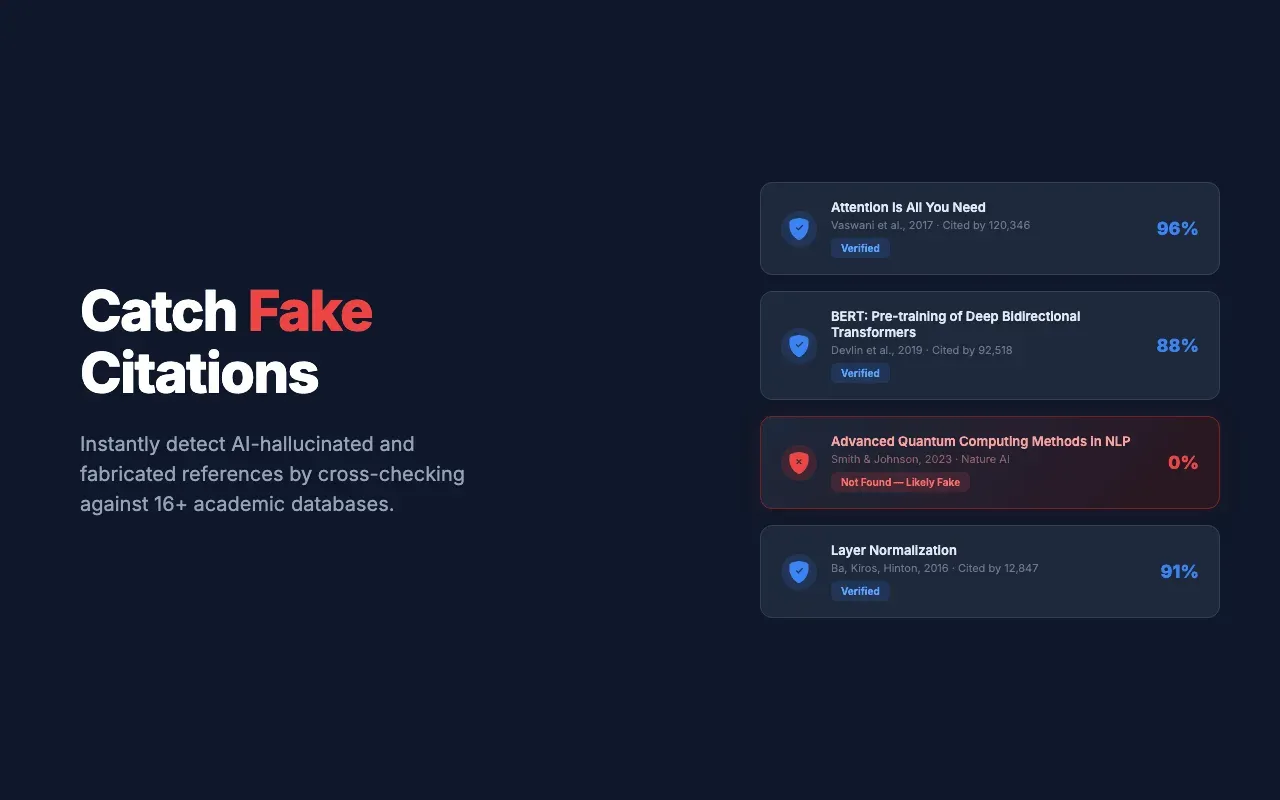
The output is built for triage rather than cover-to-cover reading. Each row carries a match percentage: a clean entry reports high confidence, a partially correct citation reports an intermediate figure, and a fabricated one reports zero. The published demonstration shows exactly that spread — a well-known machine-learning paper resolving near 100%, a popular economics title returning roughly 70% (a hint that some field, most likely the edition year, does not align), and an invented entry returning 0%.
Anchoring the problem in measurable terms, CiteTrue cites three peer-reviewed findings: 55% of bibliographic citations generated by GPT-3.5 and 18% of those generated by GPT-4 were fabricated outright; across 30 ChatGPT-generated medical papers, each reference carried an average of 4.3 incorrect components, with 93% of the papers containing a wrong PMID; and more than 10,000 papers were retracted in 2023, an annual record driven by sham papers and peer-review fraud.
Students preparing submissions. Undergraduates and master's students working with web-sourced or AI-assisted material can run a reference list before submitting, catching fabricated or malformed entries that might otherwise be read as misconduct.
Doctoral researchers. A thesis can carry hundreds of references. Manual verification at that scale is impractical, and batch checking converts an unrealistic task into a single pass.
Advisors and supervisors. Supervisors reviewing student work can surface citations that do not hold up, protecting both the student and the supervisor's own academic reputation.
Journal editors and peer reviewers. Editors screening high submission volumes can filter manuscripts with bogus references at the initial screening stage. Reviewers can validate a paper's bibliography before signing off, avoiding review errors that reflect on their own credibility.
Systematic reviewers and literature analysts. Anyone reading a paper to build on it benefits from knowing that the sources it cites actually exist, since a fabricated reference can send a research thread down a blind alley.
Developers and tool builders. The documented API and MCP endpoints allow citation verification to be embedded in editorial systems, learning platforms, or internal writing tools.
The common thread is credibility risk: every one of these groups carries some professional cost when a false reference reaches publication or review.
CiteTrue positions itself as a free citation verification tool, with a daily free quota advertised explicitly on the homepage. Beyond the free allowance, usage is metered in credits. Different operations consume credits at different rates — Deep Verify costs five credits per reference — which lets occasional users stay on the free tier while heavy users top up only when the heavier path is genuinely needed.
The economics are straightforward when weighed against the alternative. The cost of a retraction, a rejected manuscript, or a damaged review record dwarfs the cost of a credit pack by orders of magnitude. Additional credits can also be earned through referral, since inviting a colleague grants bonus credits to both accounts. Team-level details, tier boundaries, and current rates are best confirmed on the pricing page, as quotas are subject to change. Companion tools such as the Citation Finder and the AI Humanizer share the same credit balance, so the value proposition depends partly on how much of the wider suite a given workflow uses. A Mac desktop app and a Chrome extension extend access beyond the browser tab, and the platform's user guides document the API and MCP integrations for teams that want to automate checks.
CiteTrue addresses a problem that grew sharply with the arrival of generative writing tools and shows no sign of shrinking. Its core design decision — decompose each reference into fields and verify each field against multiple independent databases — is the right one, because most real citation errors are partial rather than total. A reference that points to a genuine paper with a wrong year or an incorrect volume number is just as damaging as one that points to nothing at all, and a tool that only answers "does this paper exist" would miss it.
The strengths are practical: batch processing at thesis scale, tolerant input formatting, confidence scores instead of binary verdicts, a free tier that makes casual use frictionless, and an ecosystem covering adjacent steps in the writing pipeline. Accessibility across eleven languages and three platform surfaces broadens the reach further.
The limitations are equally concrete. Verification quality depends on the coverage of the underlying indexes, and paywalled or non-indexed regional literature remains harder to confirm. The credit model introduces a metering layer that can be awkward for large, unpredictable verification jobs, and the most complex reference structures require the more expensive Deep Verify path.
For researchers, supervisors, editors, and reviewers who handle reference lists at any volume, CiteTrue is a low-friction addition to the pre-submission checklist. It is not a substitute for scholarly judgement, but as an automated first pass over a bibliography it removes a category of error that humans are demonstrably poor at catching unaided.