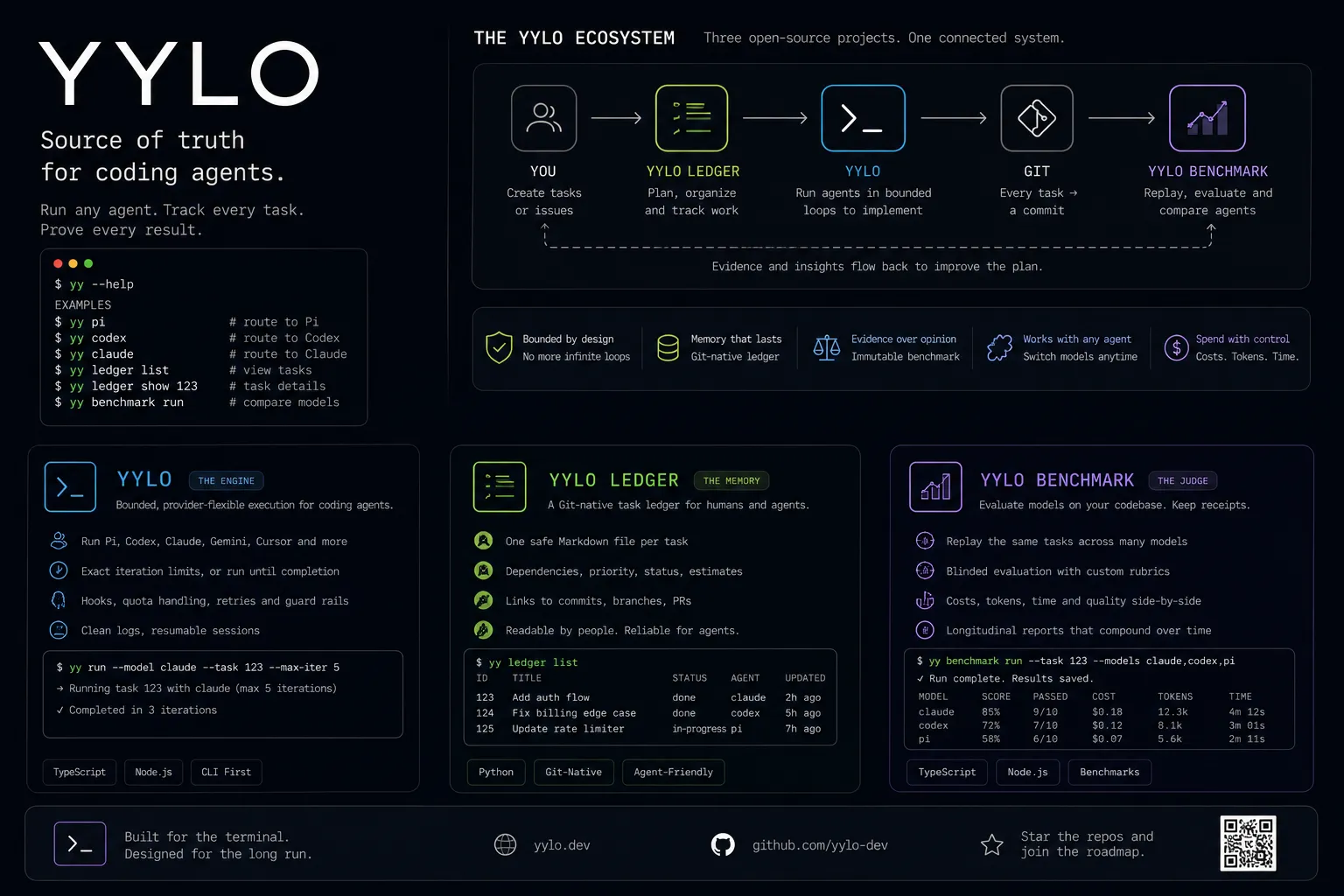
open-source, Git-native task manager and Record store for developers, automation systems, and AI coding-agent workflows. It keeps project work reviewable alongside source code without making a hosted database the canonical source of truth.
Get listed across 100+ startup directories, submitted by hand. Permanent dofollow backlinks and +25 domain rating on average.
Submit your website to get discovered by thousands of potential customers and boost your SEO.
Get ListedYYLO Ledger (GitHub) is an open-source, Git-native task manager and Record store for developers, automation systems, and AI coding-agent workflows. It keeps project work reviewable alongside source code without making a hosted database the canonical source of truth.
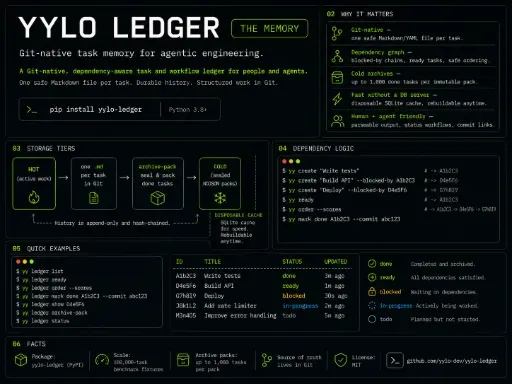
Ledger stores current task state in stable Markdown files inside the repository and retains opt-in history in segmented, hash-chained ledgers. A disposable SQLite cache accelerates broader searches but can be rebuilt from the canonical project files. This design gives teams durable, auditable task tracking that works naturally with Git reviews, commits, branches, and developer automation.
The shell-friendly yylo-ledger CLI supports creating, listing, searching, retrieving, updating, marking, tagging, and archiving tasks. Teams can model blockers, discover ready work, order tasks, and prevent invalid dependency transitions. Completed tasks can reference the Git commit that delivered them, connecting the original requirement, progress response, and implementation history.
For long-lived repositories, Ledger separates active work from older records through explicitly planned immutable cold archives. Normal discovery stays focused on hot tasks, while exact retrieval and bounded archive search preserve access to completed work. Preservation-first migration tools can inventory, plan, copy, and verify legacy wikis or artifacts without deleting the source files.
Ledger can be used independently as a command-line project task manager or combined with the wider YYLO ecosystem. YYLO CLI (GitHub) orchestrates Claude Code, OpenAI Codex, Gemini, and Pi through bounded loops, reusable workflows, session continuity, validation evidence, dedicated Git worktrees, and guarded delivery. Together, Ledger preserves task intent, dependencies, progress, and commit evidence while YYLO CLI manages agent execution and software-delivery boundaries.
YYLO Benchmark (GitHub) complements both tools with structured coding-agent evaluation. It supports validated cases, immutable plans, isolated attempts, governed grading, recovery, and bounded evidence reports.
Common YYLO Ledger use cases include Git-based task tracking, dependency-aware software backlogs, AI coding-agent task management, auditable engineering records, shell and CI automation, multi-repository coordination, and long-term project memory. Teams can adopt Ledger alone or combine all three tools while keeping task truth, orchestration, and evaluation as clear independent responsibilities.
Install the MIT-licensed yylo-ledger from PyPI. YYLO CLI and YYLO Benchmark are available as @yylo/cli and @yylo/benchmark on npm.
YYLO Ledger is an open-source, Git-native task management layer designed to give engineering teams and AI coding agents a durable source of truth. Instead of relying on ephemeral issue trackers or scattered notes, YYLO Ledger stores task intent, status, dependencies, blockers, responses, and commit evidence directly in your Git repository. It turns tasks into versionable objects that can be inspected, queried, and archived alongside your code.
yy ledger create.Unlike typical project management tools that live outside your repository, YYLO Ledger keeps task memory close to the code. This opens the door for automated agents to read current status, pick up ready tasks, and report their work—creating an engineering memory that persists beyond any single session. It’s a lightweight but deliberate foundation for the evolving “system of work” around AI-assisted development.