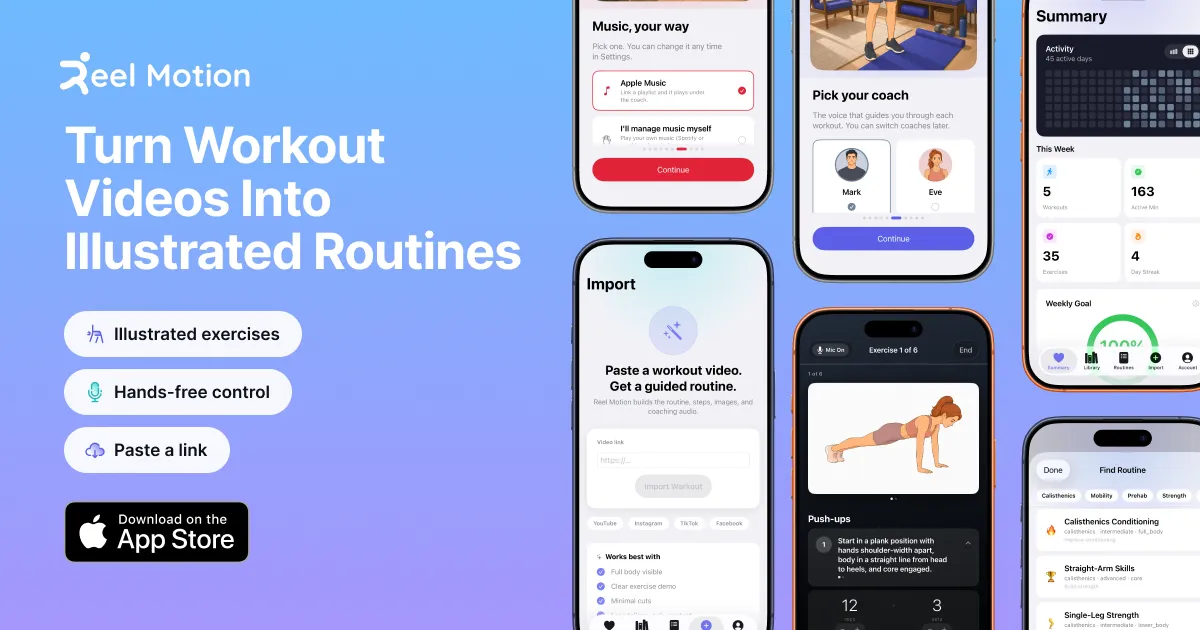
Reel Motion converts a pasted YouTube, Instagram, or TikTok workout link into an illustrated iOS routine with timers, coach audio, hands-free voice control, and Apple Health sync.
The website review directory that helps you rank on Google, ChatGPT, Claude, Gemini & Perplexity with dofollow backlinks and AI reviews.
Submit your website to get discovered by thousands of potential customers and boost your SEO.
Get ListedReel Motion is an iOS app with a narrow, well-defined job: converting workout videos saved from YouTube, Instagram, and TikTok into illustrated routines that can genuinely be followed in a gym or a living room. The gap it addresses is structural rather than motivational — social platforms surface exercise content well and organise it poorly. A pasted link returns a sequenced workout with drawn start and finish positions, timers, written step instructions, and spoken coaching cues, with completed sessions written back to Apple Health. Development and distribution sit with In Motion Marketing, and the product is iPhone and iPad only.
Link-based import from three platforms. The import flow accepts links from YouTube, Instagram, and TikTok. Reel Motion parses the source clip and extracts the exercises it contains, converting a single reference video into an ordered list of movements. Imports are unlimited across every subscription tier, so the app is not rationed by import count.
Illustrated exercise cards. Each extracted movement receives a drawn representation showing start and finish positions rather than a captured video frame. That distinction is practical: a static mid-rep screenshot is frequently ambiguous, whereas a two-position diagram communicates the intended range of motion. The app also permits unlimited illustration redraws, so a diagram that reads poorly on a small screen can be regenerated without consuming credits.
Guided player. Sessions run one exercise at a time, with timers and written instructions presented on screen. There is no timeline to scrub and no need to infer rep counts from a creator's voiceover or on-screen caption.
Hands-free voice control. Three spoken commands — start, next, and done — drive the session. The phone can stay on the floor or on a stand; the user is not required to touch the screen between sets, which is the point at which most video-based workouts break down.
Coach audio. A synthesised coach reads each step aloud while music continues playing underneath, rather than pausing playback. This is the functional difference between an app that survives a workout and one that gets muted after the first set.
Apple Health integration. Finished sessions write directly into Apple Health, keeping activity rings, exercise minutes, and history consolidated in a single location instead of split across several apps.
Routine library. A browsable catalogue of routines imported by other users sits alongside a from-scratch builder, extending the app's value beyond the videos one individual happens to have saved.
Progress tracking. Weekly minutes, streaks, and session history are surfaced in-app, with HealthKit acting as the durable, portable record.
Cross-device sync. Routines travel between iPhone and iPad under the same account, so a session started on a phone can be picked up on a tablet propped against a wall.
The workflow is deliberately compressed into three steps, and the marketing site presents them as such.
Paste a link. Any workout video from YouTube, Instagram, or TikTok is shared into the app. Reel Motion extracts the exercises from the source material rather than storing the video itself.
Run the workout. The routine plays back one exercise at a time with illustrations, timers, and a coach calling each step. Voice commands handle progression, so the session continues without screen interaction.
Track progress. Weekly minutes, streaks, and session history accumulate in-app, and finished workouts are pushed to Apple Health.
The design decision worth noting is what the app does not do. It does not attempt to be a video player with a better UI, and it does not ask users to log sets and reps manually during a session. The import step is where the manual effort lives; everything after it is intended to run unattended. That trade-off suits strength and mobility circuits, where a movement list and a timer are sufficient structure, and it is less suited to technique-heavy lifts that depend on the original instructor's camera angle and verbal form cues. For readers weighing that trade-off, the product's homepage documents the flow in full.
Setup overhead is also low by design. There is no equipment database to populate and no training programme to configure before the first import, which keeps the time from link to finished session short.
Home training without a fixed programme. The most common scenario is a user who has accumulated dozens of saved videos and follows none of them consistently. Importing converts that backlog into routines with defined beginnings and ends.
Small-space and travel sessions. Illustrated cards and audio cues work in a hotel room or a shared living space where watching a video is awkward. Timers and coach audio carry the session when the screen is out of the line of sight.
Household and family training. Family plans support up to six people through Apple Family Sharing, which makes the app viable for a household running a shared routine rather than a single individual.
Following creator programmes. People who follow a specific trainer on Instagram or TikTok can import an individual session and run it as a structured routine instead of replaying the video and pausing repeatedly.
Coaching and instruction. Instructors who assign video homework can convert reference clips into illustrated routines that clients can complete independently, with the finished session landing in Apple Health as confirmation.
Gym environments. Headphone-based audio coaching suits commercial gyms where watching a phone screen between sets is impractical, and where keeping the phone off the floor matters.
Anyone evaluating fit against a specific training style can review the feature breakdown and check out the pricing before committing to a billing period, and the support page covers account and sync questions.
Reel Motion uses a single-feature-set subscription model rather than tiered plans: every billing period unlocks the whole app, and none of the features described above are gated behind a higher price. Prices are quoted in USD.
The pricing structure contains a genuine anomaly worth flagging. The annual plan costs about $5.00 per month, while the weekly plan costs $4.99 per week and the monthly plan $19.99. The monthly tier is therefore priced well above the effective annual rate, and substantially above four weeks of weekly billing, which makes it the least rational choice for anyone planning to continue past a month. For short, defined training blocks the weekly option is defensible; for anything sustained, the annual plan is the economically obvious selection.
Value depends on substitution. Against a single personal training session, a year of annual access is inexpensive, and the feature set — unlimited imports, unlimited illustration redraws, the guided player, coach audio, HealthKit sync, and cross-device use — is delivered in full at the lowest paid tier.
Reel Motion is a focused, well-scoped utility rather than a general fitness platform, and it is strongest where it refuses to overreach. The import-and-illustrate model solves a real friction point: saved workout videos rarely get followed a second time, and the app converts them into something with timers, cues, and an ending. Hands-free voice control and coach audio are the features that make the format work in practice, and HealthKit integration prevents the app from becoming another silo of fitness data.
The limitations are equally clear. The app is iPhone and iPad only, with no Android, web, or watch client documented. Generated illustrations replace the original instructor's footage, which will not satisfy users who rely on camera angle and verbal form cues, and there is no free tier — the weekly plan is the lowest-cost entry point. The testimonial section on the homepage is explicitly labelled placeholder content, so there is no verified user evidence to weigh yet, which is a reasonable reason to treat early adoption as an experiment.
For anyone with a backlog of social workout videos and a structure problem rather than a motivation problem, Reel Motion is a credible tool at a fair annual price. Those needing detailed programme periodisation, technique coaching, or non-Apple device support should look elsewhere.