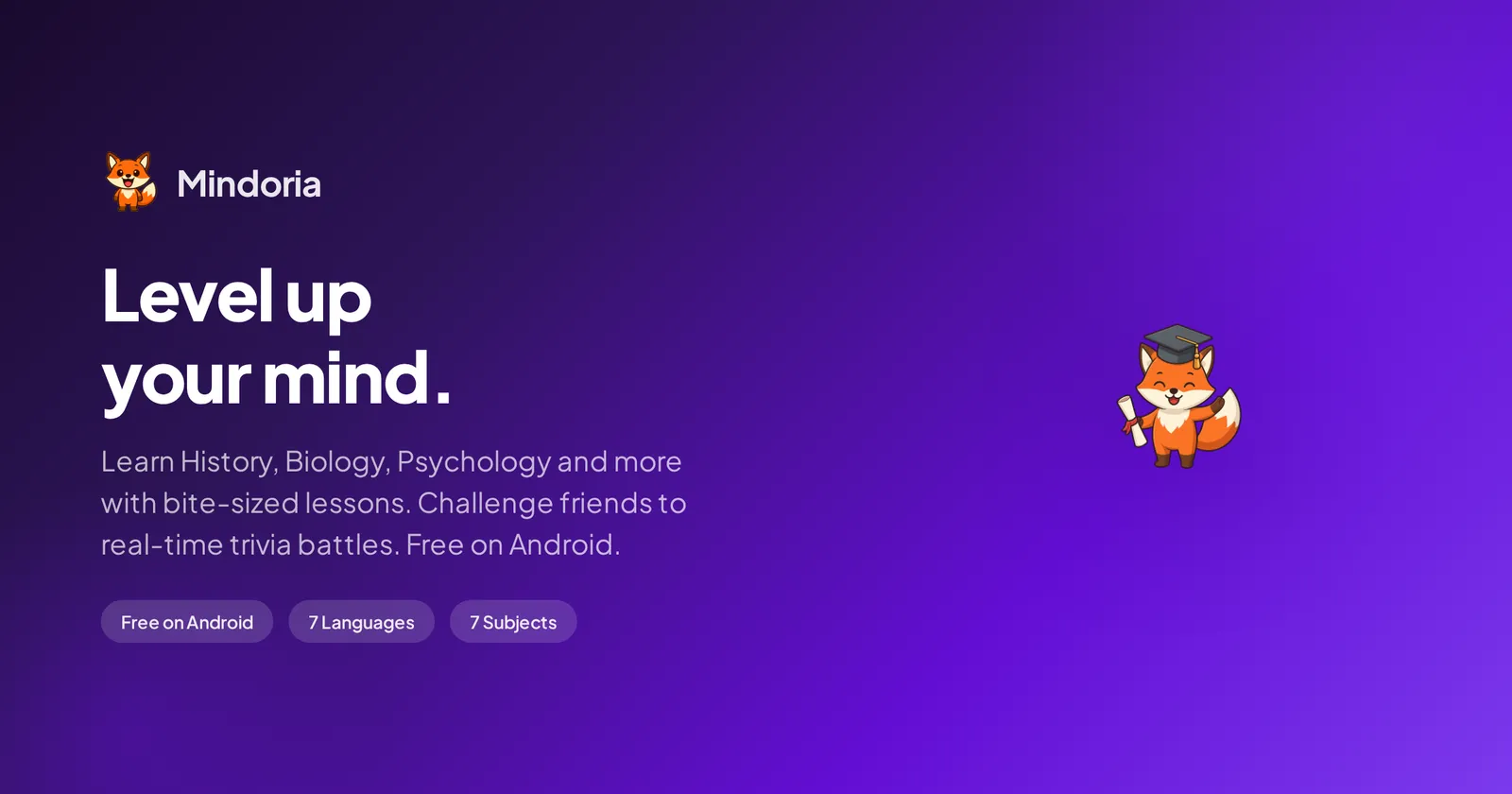
Mindoria is an Android micro-learning app that pairs roughly 650 bite-sized lessons across ten subjects with spaced-repetition review and live, ELO-ranked PvP trivia battles.
Revenue analytics for SaaS founders. See what actually drives your growth.
Submit your website to get discovered by thousands of potential customers and boost your SEO.
Get ListedMindoria is an Android-first micro-learning application that compresses ten academic disciplines into daily sessions of roughly ten minutes. The product stacks three mechanisms on top of one another: short read-and-quiz lessons, a spaced-repetition scheduler that resurfaces material near the point of forgetting, and live player-versus-player trivia matches tied to an ELO rating. The published catalogue runs approximately 650 lessons distributed across history, biology, psychology, sociology, economics, anthropology, political science, chemistry, geography, and neuroscience, and the interface is localized into seven languages. Instead of replacing a textbook, the app targets the habit layer of learning — small, repeatable wins that fit inside a commute, a lunch break, or a queue.
Ten-minute lesson units. Each lesson opens with a plain-language explanation and closes with a handful of comprehension questions. The session length is a deliberate constraint: short enough to complete between other obligations, long enough to leave the learner with one discrete concept rather than a scattered overview.
Spaced-repetition engine. The app tracks which material is decaying and reintroduces it when a refresher is most likely to be needed. This reframes review as a targeted queue rather than a bulk re-read, and it is the mechanism most responsible for the platform's retention claims.
Real-time PvP battles. Two players answer an identical question set against a clock; the higher score takes the round and the result feeds an ELO rating. Opponents can be invited directly by friend or matched automatically against someone at a comparable rating, and subject selection lets a player lean on a strong discipline.
Cross-subject knowledge graph. Disciplines are linked rather than siloed, so an economics lesson can reference psychology or political science. The result is a connective curriculum structure instead of a shelf of unrelated decks.
Progress telemetry. XP, levels, daily streaks, hearts, leaderboards, and PvP-specific achievement badges supply the motivational scaffolding. Hearts gate mistakes, streaks gate consistency, and leaderboards gate competitiveness.
Subject breadth on a release cadence. Ten subjects ship at launch with roughly 60–70 lessons each, and the roadmap promises a new subject every month.
Editorial layer. A companion blog publishes long-form explainers that mirror the in-app material, including a tour of the six neurotransmitter systems in Mindoria's guide to brain chemistry and an analysis of anomalous water behaviour in its explainer on water's chemistry. The full archive is browsable at the Mindoria blog.
Getting started takes three steps: install from Google Play, create a free account, and pick a subject. The dashboard then presents a compact status panel — current streak, remaining hearts, weekly activity grid, and a rotating "Did You Know?" fact — alongside a resumable lesson card showing the subject, module name, lesson title, and progress bar.
The daily loop is linear and short. A lesson card is opened, the explanation is read, and a small set of multiple-choice questions is answered. Correct responses award XP (commonly around +15 to +25 per lesson) and increment the streak; incorrect responses consume a heart from a visible pool of four. Completing a lesson advances the module bar and returns the learner to the dashboard, where the next unfinished lesson is already queued.
PvP works as a separate parallel track. After selecting a subject, the player either invites a friend or joins matchmaking, then both participants answer the same questions simultaneously while a clock runs. The head-to-head scoreboard displays both totals live — a 42-to-38 result, for example — and the winner absorbs the rating change. PvP achievements accumulate independently of the lesson-side progression.
The spaced-repetition layer operates underneath both tracks. Rather than presenting a fixed revision list, the app decides which previously completed lessons warrant another pass and injects them into the daily queue. Because the gate is timing rather than volume, the review load stays roughly constant even as the completed-lesson count grows.
Commuters and shift workers. The ten-minute ceiling is the defining design decision. Someone with a fragmented schedule can complete a lesson inside a single subway ride without carrying materials or planning a study block.
Students supplementing coursework. Psychology, economics, biology, and political science decks map onto introductory university and high-school syllabi, making the app viable as a lightweight revision layer between lectures.
Trivia and quiz competitors. The ELO ladder, friend challenges, and timed format translate directly into a competitive hobby. Subject selection within PvP rewards specialization, so a history specialist can compete on familiar ground.
Lifelong learners sampling new fields. A 60–70 lesson arc across anthropology or neuroscience is short enough to sample a discipline without committing to a course, and the knowledge graph indicates where that discipline touches others.
Multilingual learners. With seven interface languages spanning English, Portuguese, Spanish, Italian, German, Japanese, and Korean, the app is usable for non-English speakers and can double as light vocabulary exposure for language students.
Study groups and classrooms. Friend-based PvP invitations give small cohorts a shared competitive surface without any institutional tooling.
The core product is free: lessons, spaced-repetition reviews, every subject, and PvP access carry no charge. Two optional tiers extend convenience rather than content. Plus adds extra hearts, more daily PvP rounds, faster heart refills, and a weekly streak freeze. Premium removes the heart ceiling entirely, makes PvP unlimited, and grants additional streak freezes. A free account is mandatory, primarily so progress, streaks, and ELO ratings can sync across devices.
Value depends on usage intensity. A casual learner who completes one or two lessons a day never encounters a paywall, because the free tier covers the full curriculum and the entire subject catalogue. The subscription only becomes relevant for players who exhaust the heart pool daily or who want unlimited competitive matches — a narrow, high-frequency segment. Against paid course platforms that charge per course, the free-forever positioning is unusually aggressive. Two caveats belong in any evaluation: distribution is Android-only, with iOS still on the roadmap, and the marketing copy is internally inconsistent about scale — subject cards advertise 60–70 lessons each, the FAQ claims 90+, and the language list varies between seven and the thirty locales referenced in the site's alternate-language tags. Prospective buyers should treat the lower figures as authoritative.
Mindoria occupies a sensible middle ground between flashcard utilities and full course platforms. Its strengths are structural: a strict ten-minute session cap, a spaced-repetition scheduler that keeps review volume flat over time, and a competitive layer with real stakes in the form of ELO ratings and live head-to-head rounds. The free tier covering the entire curriculum is a genuine differentiator, and the seven-language interface widens the addressable audience considerably.
The limitations are equally clear. Android exclusivity shuts out a large share of the mobile market, the convenience-gated mechanics around hearts and daily PvP rounds create friction precisely for the most engaged users, and per-subject depth caps out at introductory level — this is a habit builder, not an exam-preparation instrument for advanced material. The messaging inconsistencies around lesson counts and language support also warrant caution when evaluating the catalogue at face value.
For learners who want a sustainable daily knowledge habit with a competitive edge, the app is a strong fit and costs nothing to trial. For those who need deep specialization, structured certification, or iOS support, it remains a partial solution until the roadmap catches up.