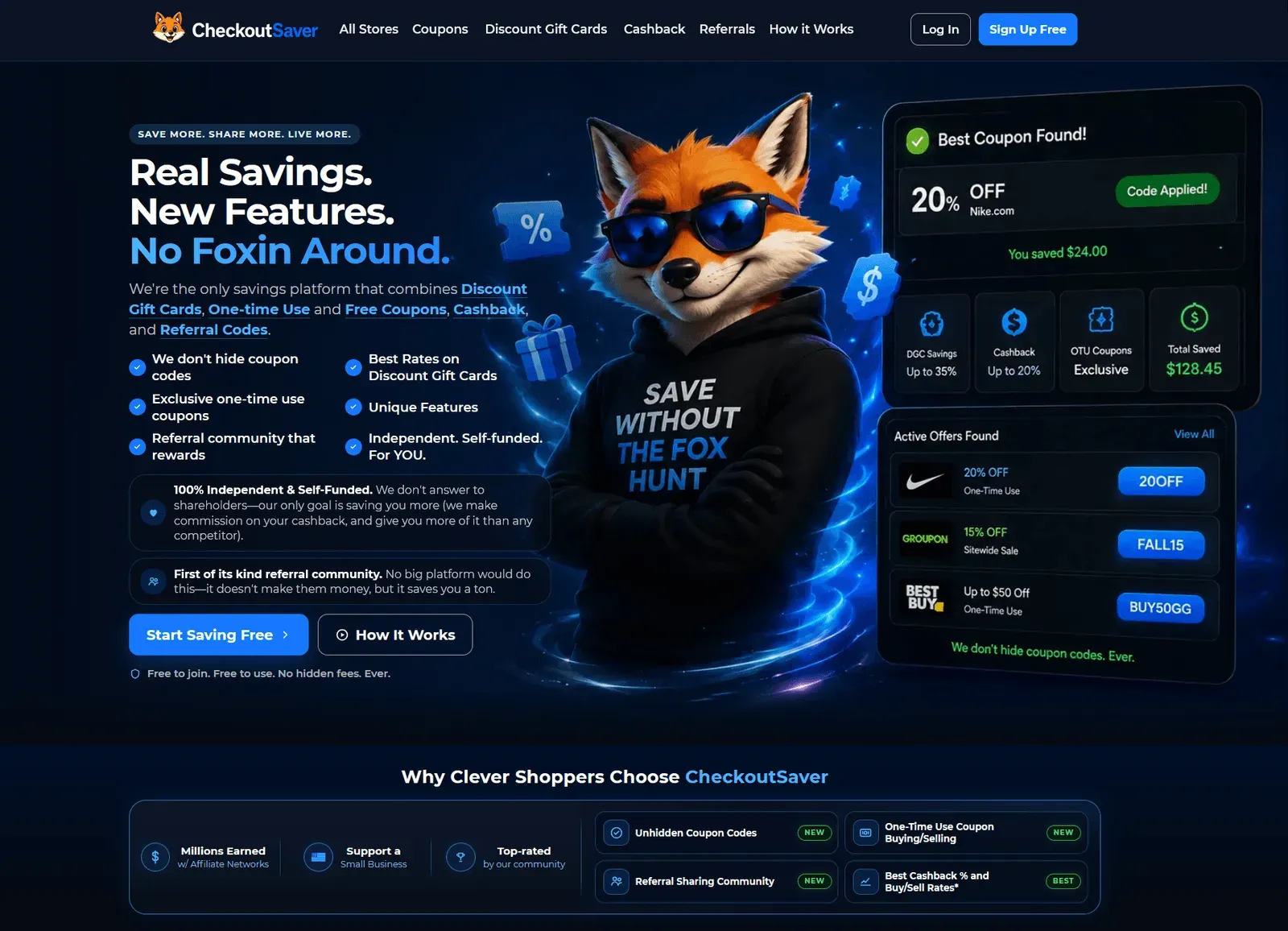
Checkout Saver merges cashback, unhidden coupon codes, discount gift cards, one-time-use coupon trading, and referral code sharing into a single independent savings platform.
Revenue analytics for SaaS founders. See what actually drives your growth.
Submit your website to get discovered by thousands of potential customers and boost your SEO.
Get ListedCheckout Saver is an independent and self-funded consumer savings platform that consolidates several money-saving mechanisms into one account. Rather than focusing solely on cashback or coupon codes, the service complements standard loyalty perks—discount gift cards, visible coupon codes, cashback—with a one-time-use coupon marketplace, a communal referral database, an eBay bid sniper, a price-drop tracker, and a receipt & warranty utility. The “10+ ways to save” tagline is therefore close to accurate, and the different tactics can be stacked on the same purchase for larger discounts.
The platform’s main differentiator is transparency. Competitors often hide code strings behind pop-ups, but Checkout Saver shows the full code on store pages. The platform also states that it passes most affiliate commission back to the member because it is self-funded and does not answer to shareholders. This explains why it has attracted a niche but engaged following.
Cashback forms the core layer. The site lists more than 5,000 participating retailers and advertises rates up to 35%. Each store page clearly shows the exact percentage, and the cashback directory can be searched by store name or browsed alphabetically. The dashboard tracks pending and paid cashback, with payout available after a minimum threshold. Because Checkout Saver’s cost structure is lean, it claims to return a higher proportion of the affiliate commission to the shopper than large rivals.
Checkout Saver operates both buy and sell sides for gift cards. Shoppers can purchase cards from well-known brands like Amazon, Target, and Best Buy at below face value, then instantaneously redeem them at checkout. Sellers can list unwanted cards and receive a payout that the site advertises as an industry-leading rate—typically around 85% of the card’s face value. The platform validates the card balance before listing. The gift card buy page explains the full buying process; card discounts can be combined with a coupon and cashback for a single purchase.
Regular coupon codes are displayed openly; there is no mandatory “click to reveal”, no forced email signup, and no download gate. This saves time and cuts down on the inconvenience common with other coupon sites. Expiration dates are visible, and a report button helps maintain code quality. The free coupon category is distinct from one-time-use codes, giving shoppers a wide playlist to pull from.
A genuine differentiator for the platform is its one-time-use coupon marketplace. When a retailer sends a unique, single-use code to one person, that code is usually regarded as non-transferable and not listed publicly. Checkout Saver built a section where those code owners can sell the OTU code, and other users can buy it. The seller provides and validates the code; the buyer receives it after purchase. This creates a secondary market for coveted discount coupons that otherwise would go unused.
The referral community is another rare feature. Users can submit referral codes they have for certain stores or services, and others can use them when signing up. Many referral programs grant a bonus to both the new user and the person who referred them; Checkout Saver’s community harvests these offers in one place. Larger platforms tend to block the sharing of referral links because it harms their affiliate economics, so this feature aims to put the shopper first.
The free Chrome extension acts as a hands-free assistant. While browsing a supported store, it automatically shows cashback availability, searches the coupon database, and displays any discounted gift card balance that can be used. At checkout, it can apply the best discovered coupon code and remind the user to activate cashback. The extension also encapsulates some of the auxiliary tools, such as the eBay bid sniper and price drop alerts.
The process starts by creating a free account via email, Google, Apple, or Facebook. Once inside the dashboard, all major functions are available from a unified menu. The official How It Works page explains the overall requirements, but the flows are straightforward.
Cashback activation begins when the user either visits a store page on Checkout Saver and clicks the call-to-action or opens the retailer site while the browser extension is enabled. The extension prompts for cashback activation. After the transaction is complete, the earnings are visible in the dashboard. Payouts are processed through the available payment methods.
Coupon usage requires no hidden steps. Browse the store’s coupon list, copy the code, and paste it during checkout. For one-time-use coupons, the code is delivered immediately after payment, and the seller must ensure that the code is valid for one use only.
Gift card purchases work like a store checkout: after selecting a card and paying, the shopper receives the card number and PIN instantly. Selling is similarly direct: the user submits the card ID, receives a quote, and upon approval the payout is sent.
Referral codes are posted by community members and are immediately visible. No platform fee is charged for using this feature.
Extension installation takes under a minute. It piggybacks on the checkout experience by saving codes and notifying the user when cashback has not been activated.
Checkout Saver does not charge a subscription fee. All membership features—coupon viewing, cashback collection, referral community access, extension installation, and utility tools—are free. Revenue is generated when Checkout Saver receives an affiliate commission from a retailer, and the platform passes a majority share to the user. The service also takes a margin on gift card purchases and OTU coupon sales, which is the expected cost of using such a marketplace.
For cashback users, the effective “cost” is the portion of commission the site retains. This is generally lower than what larger portals keep, although the store network is smaller. There are no hidden fees and the platform explicitly states in its help documentation that no account fees will be charged.
The OTU coupon marketplace and referral community do not charge viewers; the seller or code vendor bears the cost in the form of a commission. This structure makes the service economical from the consumer’s perspective, since cashback can be paid out through a method like PayPal and no monthly charge is imposed.
Checkout Saver is more than a cashback portal; it is a diverse collection of shopping utilities. The wide-ranging product set means a shopper can consolidate their entire savings habit—coupons, discounted gift cards, one-time-use codes, referrals, auction tools, warranty tracking, and price monitoring—inside one account.
The most imaginative additions are the one-time-use coupon marketplace and the referral community. These features may not exist on larger platforms because they reduce those sites’ affiliate revenue. Checkout Saver’s willingness to build them anyway signals a user-oriented approach, even if the company’s budget is smaller.
Limitations remain: store coverage is not as extensive as Rakuten’s or Honey’s, and the extension is Chrome-only, which excludes Safari and Firefox users from the full experience. Still, the absence of hidden coupon codes and the honest no-fee policy give the platform strong character.
For someone who wants to stack multiple savings channels on one order without downloading several different apps, Checkout Saver is a compelling option. The cashback page illustrates the breadth of participating retailers, and trying the service costs nothing. It is a practical experiment that will likely pay for itself with the first use.