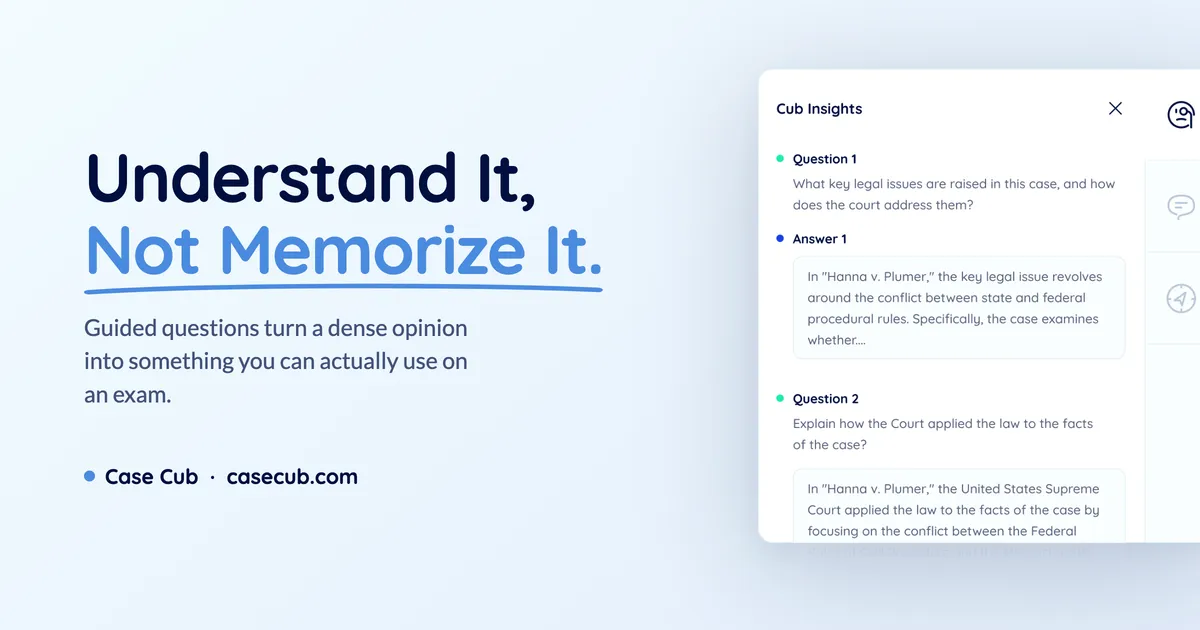
An AI-driven legal study hub with a 20,000+ case brief library, automated quiz and flashcard tools, and intelligent chat support—built to streamline law school exam preparation.
The website review directory that helps you rank on Google, ChatGPT, Claude, Gemini & Perplexity with dofollow backlinks and AI reviews.
Submit your website to get discovered by thousands of potential customers and boost your SEO.
Get ListedCase Cub is a web-based study platform specifically engineered for law students. It combines an extensive repository of over 20,000 interactive case briefs with AI-driven utilities like quiz generation, spaced-repetition flashcards, and a conversational legal assistant. The platform aims to replace the fragmented workflow of reading textbooks, writing outlines, and manually creating study aids with a unified digital workspace. This review covers the core features, user experience, practical applications, and pricing to determine whether it delivers on its promise.
Case Cub boasts a database of 20,000+ interactive case briefs spanning legal history from the 1600s to modern rulings. Each brief is structured to highlight facts, procedural history, issues, holdings, and reasoning—the standard IRAC framework. Full court opinions are also included with smart navigation, enabling students to jump directly to relevant sections. The interactive elements go beyond static text, encouraging active engagement with the material.
The Quiz Studio generates custom quizzes from uploaded legal materials or existing briefs. It supports multiple question types, including multiple-choice, short answer, and issue-spotting scenarios. Performance analytics track accuracy and speed, identifying weak areas. Timed practice mode simulates exam conditions, making it a practical tool for midterms and finals.
Flashcards are automatically created from case briefs and user content. The system employs spaced repetition algorithms to schedule reviews at optimal intervals, reinforcing long-term retention. Users can organize decks by course or topic, monitor progress, and adjust difficulty. This feature reduces the manual effort of flashcard creation while maintaining effectiveness.
Cub Chat is an always-available AI assistant trained on legal concepts. It can answer specific questions about cases, explain doctrines, and provide citation assistance. The chat interface allows for follow-up questions, making it a useful study partner for clarifying ambiguities in lecture notes or textbook readings.
The platform includes dashboards that visualize study time, quiz scores, and flashcard mastery. This data helps students allocate time strategically. Exam prep tools include practice questions and structured study materials, aligning with actual law school assessment formats.
Getting started with Case Cub requires signing up for a free trial. The interface is clean and organized, with a search bar for finding cases by name, citation, or topic. Upon selecting a case brief, users can read the concise summary or switch to the full opinion view. From any brief, actions like "Generate Quiz" or "Create Flashcards" are one click away.
The Quiz Studio accepts custom text uploads (e.g., outlines or lecture notes) and generates questions in seconds. Users can adjust the number of questions and difficulty. After completing a quiz, results show per-question feedback and links back to relevant briefs.
Flashcards can be created individually or batch-generated from a case. The spaced repetition algorithm schedules reviews, and the interface shows due cards. Users can mark confidence levels, which influences future scheduling.
Cub Chat operates in a sidebar or full-screen mode. Queries typed in natural language return explanations with citations. The assistant can also summarize cases, compare holdings, or generate hypotheticals for practice.
The entire experience is video-demonstrated on the landing page, with hover-to-play clips showing the workflow. No install is required, and the platform works across devices via browser.
Case Cub serves multiple segments within legal education:
The platform also supports group study: students can share flashcard decks or quiz results, though collaboration features are not explicitly highlighted.
Case Cub operates on a subscription model with a free trial. The pricing page indicates no long-term commitments, with the option to cancel anytime. While exact pricing tiers are not visible on the homepage, the structure appears to be a standard monthly or annual SaaS plan. Given the breadth of features—case briefs, quiz engine, flashcards, and AI chat—the value proposition centers on time efficiency. A student who manually writes briefs and flashcards spends hours weekly; Case Cub automates these tasks. The free trial allows full access, making it easy to evaluate the tool before committing. For a detailed breakdown of tiers, check out their pricing. Those interested in the academic background can visit the about page to learn more about the team behind the platform.
Case Cub is a compelling all-in-one study solution for law students who want to move beyond static reading and manual outline creation. The 20,000+ case brief database is impressive, and the AI-powered quiz generation and spaced-repetition flashcards are genuinely useful. Cub Chat adds a layer of interactive learning that typical study aids lack.
However, the quality of AI-generated questions and explanations depends on the underlying model, and students should verify accuracy for nuanced legal topics. The cost may be a barrier for those on tight budgets, though the free trial mitigates initial risk.
Overall, Case Cub is recommended for law students who struggle with time management or retention. It is not a replacement for reading full opinions, but it is an extraordinarily efficient supplement. For anyone serious about improving study productivity, exploring the case library is worth the time.