Hands-on review of Alternative.tools, an independent curated directory for discovering and comparing new web tools, featuring detailed product reviews, founder-focused resources, and a straightforward submission process.
AI-powered SEO content on autopilot. Use code ALTERNATIVETOOLS for 10% off.
Submit your website to get discovered by thousands of potential customers and boost your SEO.
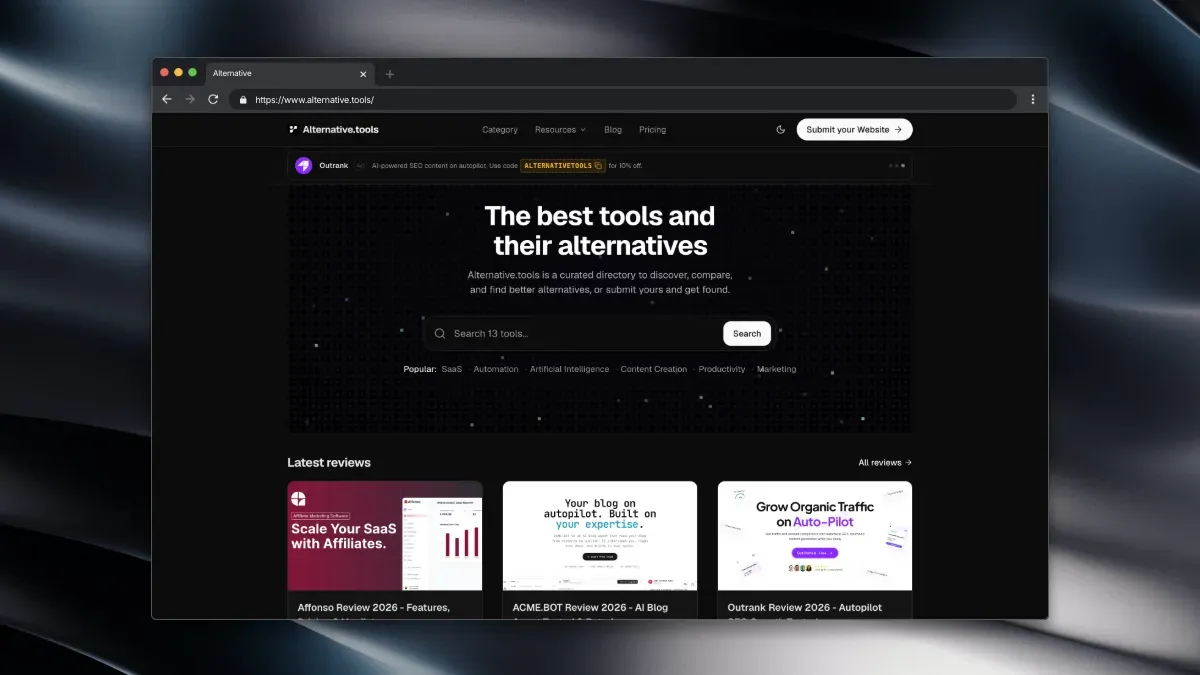
Get ListedAlternative.tools is a meticulously curated directory that promises to simplify the discovery of new websites, tools, and SaaS products. Unlike sprawling aggregator platforms that index everything, this site focuses on a hand-picked selection of innovative solutions. Currently boasting a modest catalog of 13 tools, it positions itself as a quality-over-quantity resource. The platform also delivers independent editorial reviews, practical guides, and a submission mechanism for founders seeking visibility. This balance of curation and education makes it a compelling destination for product teams, marketers, and early adopters.
Alternative.tools packs several useful features into a clean, functional interface:
Focused Directory: The core listing is organized into categories like SaaS, Automation, Artificial Intelligence, Content Creation, and Productivity. Each product entry shows its logo, domain, a concise description, and a category badge, allowing users to quickly scan and compare.
Independent Reviews: The blog section features in-depth reviews of individual tools. These articles go beyond feature lists, covering pricing, usability, and ideal scenarios. For example, the review of Outrank examines its automated SEO approach and practical implications for digital marketers.
Top Products Carousel: A prominent homepage section showcases six featured tools, ranked by editorial preference. This highlights trending solutions and gives users immediate entry points without searching.
Recently Listed Grid: New additions—such as Kinetic Pricing for pricing research and V2Fun for AI-driven 3D modeling—are displayed in a neat grid, helping early adopters spot fresh startups before they become mainstream.
Search & Filters: A large search bar enabled users to query the database; currently it returns results from the existing 13 tools. Popular category chips (SaaS, Automation, etc.) provide one-click filtering, which will become even more powerful as inventory grows.
Educational Resources: The Resources menu links to Guides, How-to playbooks, and Glossary. The featured guide on the homepage reviews the best SEO tools of 2026, offering an authoritative comparison. These assets elevate the platform from a simple directory to a knowledge base.
Unique Extras: The footer contains a link to a “Google Graveyard,” a creative section documenting discontinued Google services, plus an llms.txt file for AI-driven discovery. These additions show thoughtful attention to niche audiences.
Submission Portal: A dedicated “Submit your Website” button in the header allows founders to propose their products. This is the primary growth engine and directly supports the directory’s expansion.
Transparent Sponsored Ads: The homepage currently displays a sponsored placement for Web Review. Clearly labeled as “Ad,” this maintains a separation between organic and paid content, preserving user trust.
Using Alternative.tools is remarkably straightforward. On the homepage, the hero area invites you to search or explore by category. Clicking a category, such as Artificial Intelligence, displays all matching tools. Each tool card is a clickable link either to the product’s own site or to an internal review page when available. For instance, selecting the ACME.BOT listing leads to a detailed review that discusses its AI writing workflow, output quality, and pricing—giving you concrete insights before you ever visit the vendor’s website.
The search bar performs instant filtering across the existing inventory, as evidenced by the placeholder “Search 13 tools…”. This minimalism is a double-edged sword: it’s fast and clean, but the limited dataset may not satisfy broad queries. However, the platform compensates with the “Best for…” section, which curates tools by specific use cases, and the guides that compare categories like SEO software.
For founders, the submission flow is the key interaction. After clicking “Submit,” you’re likely asked for the product URL, category, and a short pitch. The editorial team then evaluates the submission against their guidelines. Once accepted, the tool appears in appropriate category pages and may be featured on the homepage. If the team decides to write a full review, that content gets published on the blog, giving the product valuable backlinks and exposure to a targeted audience.
Alternative.tools serves multiple practical scenarios:
Startup Founders: Use the directory to monitor emerging competitors in your niche. The “Recently Listed” section is a goldmine for spotting new entrants. Simultaneously, submitting your own product can generate high-quality referral traffic and authoritative backlinks, especially in the early days of your launch.
Marketers & SEO Specialists: The guides and glossary provide actionable education on topics like directory submission and SEO tactics. The directory itself can be used for competitor backlink analysis—if a rival is listed, you can see their category placement and description, informing your own pitch.
Product Managers: When evaluating new tools, a curated list of 13 is far more digestible than hundreds of search results. PMs can quickly compare categories like Analytics or Social Media, using internal reviews to shortlist candidates for deeper evaluation.
Agency Owners: The platform helps agencies build technology stacks for clients. A quick scan of the Sales and Marketing categories reveals tools like Fuzzy AI for LinkedIn outreach and Outrank for automated SEO. The reviews highlight integrations and pricing, which are critical for client proposals.
Freelancers & Creators: Freelancers need productivity tools and content creation software. The directory’s categories cover Design, Content Creation, and Productivity, making it a useful starting point for personal recommendations or client consultations.
Alternative.tools does not publicly disclose its pricing structure on the homepage, but the existence of a dedicated pricing page indicates a freemium model. Likely, browsing the directory is free, while submitting a website, getting a featured placement, or receiving a full editorial review carries a fee. This structure aligns with the site’s early-stage growth—basic access is open, while monetization comes from founders eager for visibility.
For users, the value lies in the time saved and the human curation. Instead of wading through generic lists, you get a filtered, best-of selection with professional critiques. For founders, the opportunity to be one of only 13 tools currently listed means significantly higher visibility than on larger directories. Furthermore, the editorial team’s willingness to write in-depth reviews adds credibility that a simple link listing cannot match.
Alternative.tools is a well-designed, honest directory that prioritizes depth over breadth. Its curated approach, transparent advertising, and educational resources make it a trustworthy source for discovering new web tools. That said, the current database is extremely small—only 13 tools—which limits its utility for broad searches. The site’s growth depends on community submissions and the editorial team’s ability to maintain quality. Early-stage founders should consider submitting their products now to gain a beachhead in a growing directory. For regular users, the platform is worth monitoring, especially as the inventory expands. If it can scale without sacrificing editorial independence, Alternative.tools has the potential to become a respected resource in the tool discovery space.