Welo Badge Review 2026: Features, Pricing and Verdict | SumoDir
Welo Badge Review 2026: Features, Pricing and Verdict
This Welo Badge review for 2026 examines the Welo Trust Standard, the 0-100 Trust Score, verified reviews and widgets. It also covers the undisclosed pricing, roadmap-only API and which online businesses benefit most.
Welo Badge is a trust certification for online businesses. It combines a clickable badge on the merchant's site with a public profile, called the Welo Page, that documents what was checked. The product addresses a familiar gap: shoppers have few quick ways to tell an established store from a convincing imitation, and legitimate smaller brands have trouble proving they are real.
Certification follows the Welo Trust Standard (WTS), currently version 2.4. The standard covers four areas: business identity, website security, transparency and legal compliance, and commercial reliability. According to the site, the checks mix manual review with automated analysis and are performed by an analyst team that describes itself as an independent third party.
In market terms, Welo Badge falls between a classic trust seal and a review platform. The badge acts as the seal. The Welo Page adds a published score, company documents, verified reviews and a company-updates feed. The project launched in 2024, operates as Welobadge, LLC, and says it has no outside investors. Consumers can browse Welo Pages and run a private website check for free. Businesses pay to be certified.
Key Features
Welo's feature overview groups the product into verification, public page, reviews, dashboard, widgets and team tools. The most relevant pieces for evaluation are these:
Business verification and Fundamental Requirements. The Welo team reviews legal identity, company documents and the website before a badge goes live. The FAQ describes five pass/fail conditions: real presence, verifiable identity, usable policies, no critical red flags, and accurate submissions.
Welo Trust Score. Each certified company receives a score from 0 to 100, weighted across eight areas: identity and ownership, security, privacy, payments and checkout, legal and policy, support, reputation, and risk signals. A strong score cannot offset a failed fundamental requirement.
Blue and Gold Checkmark. The Blue Checkmark marks companies that meet the baseline and reach a solid reliability level. The Gold Checkmark requires a score of at least 90 plus one completed re-check cycle, and the FAQ states it cannot be purchased.
Pros
+The Welo Trust Standard (v2.4) is published, with five pass/fail Fundamental Requirements and explicit exclusions that visitors can check.
+The Welo Trust Score runs from 0 to 100 across eight weighted areas, and a strong score cannot offset a failed fundamental requirement.
+Verified Reviews are tied to a real interaction, accept photos or videos, and can be invited through CSV upload, scheduled sends, direct links or QR codes.
+Widget Studio offers five widgets, including Floating Badge and Video Reviews, each installed through one company-specific code snippet that works on any website builder.
+Ongoing monitoring of complaint spikes, billing or checkout changes and security issues can trigger a re-check, and the badge can be suspended or revoked.
Cons
–Prices, billing intervals, activation fee amounts and per-plan limits such as the monthly review invitation allowance are not published, so costs cannot be compared without contacting sales.
–Certification is paid for by the businesses being evaluated, and the claim of independence rests on the company's own description, with no customer counts or outside audit disclosed.
–API access, CRM integrations, public replies to reviews and Welo Search are only roadmap items, which limits automation and integration for teams that need them now.
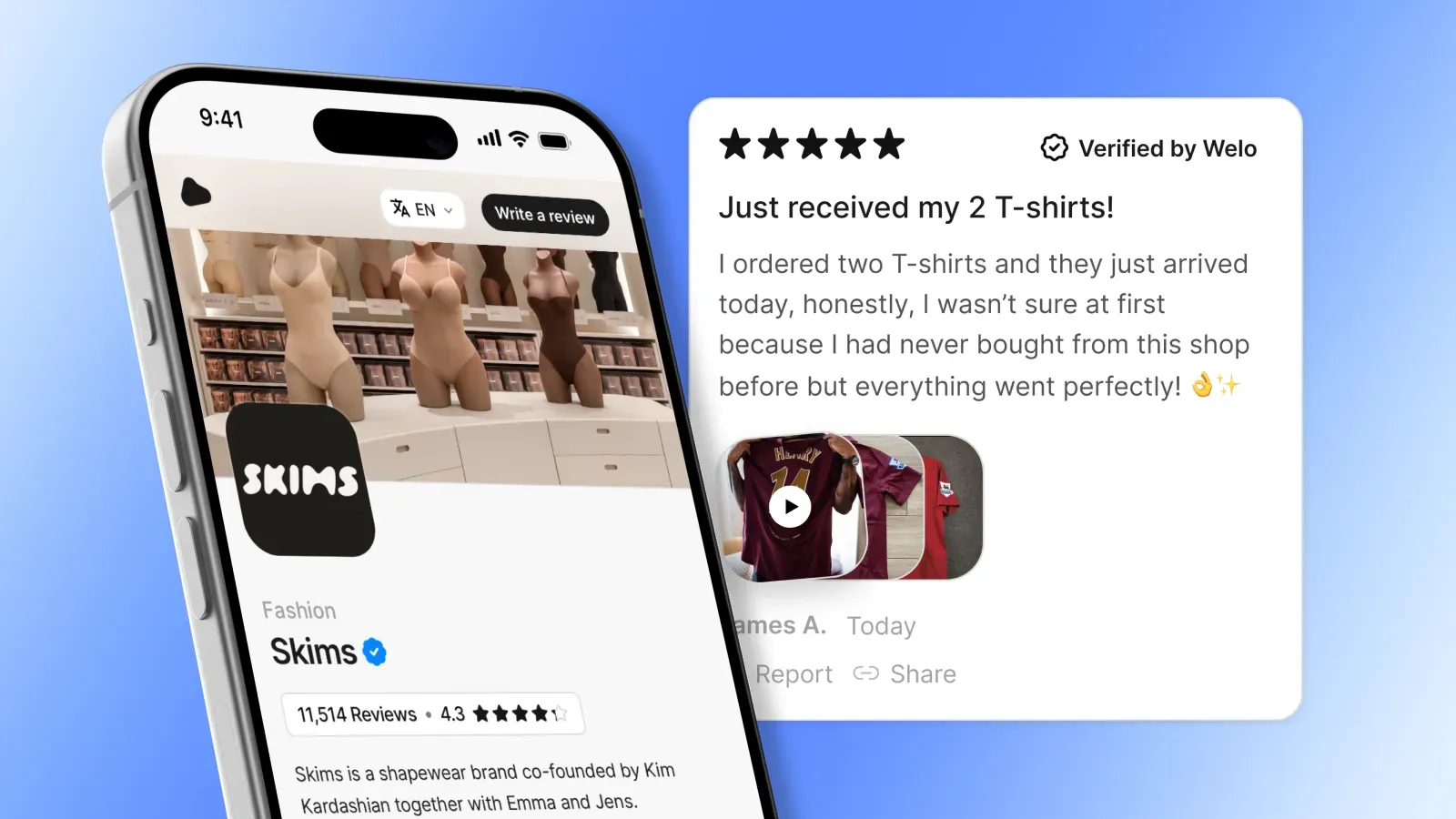
Welo Page. This public profile combines verification status, score, reviews and company details such as logo, description, size, support and legal links. The editor offers live preview, and Welo reviews changes before they are published.
Verified Reviews. Reviews are tied to a real interaction and can carry photos or videos. Businesses invite customers by CSV upload, send immediately or on a schedule, and track invitation status and conversion. A direct review link also works in receipts, chats or QR codes.
Widget Studio. Five widgets are available: Floating Badge, Reviews Widget, Video Reviews, Tag Widget and Full Review. Each is installed through a single company-specific code snippet that the site says works on any website builder.
Dashboard and Analytics. The client portal offers a live overview, impressions and unique visitors against the prior period, an activity log, notifications and a "Grow checklist". A "Status & action required" list tracks applications and pending requests.
Team roles, billing self-service and a referral program round out the account side. API access, CRM integrations and public replies to reviews are listed only as roadmap items.
How It Works
The process starts on the business side with an application and ends with a live badge and ongoing monitoring.
Apply. Companies register through the Welo portal. The FAQ describes access as invitation-based: the team screens the application first and then invites eligible companies into verification.
Complete verification. Inside the client portal, the business submits identity details and supporting documents. Private files belong in the Documents area, not in public page fields. The site says most complete verifications finish within a few days, with detailed feedback.
Receive a decision. Passing the Fundamental Requirements produces a Trust Score and a Blue Checkmark. A failed company often gets a summary of what to fix and may reapply.
Build the Welo Page. The business edits its profile, uploads policies and certificates, and publishes updates. Edits may pass through Welo review before they appear publicly.
Install the badge. A snippet is generated in Widget Studio and pasted into the site, following the installation documentation. Welo detects the widget automatically once it is live.
Collect reviews. Invitations go out by CSV, link or QR code, and submissions are subject to the limits and moderation rules shown in the account.
Maintain status. Welo monitors complaint spikes, major billing or checkout changes and serious security issues. Any of these can trigger a re-check, and the badge can be suspended or revoked.
Visitors never need an account. They click the badge, land on the Welo Page hosted on welobadge.com, and confirm the status is active.
Use Cases
Small ecommerce brand without name recognition. A new direct-to-consumer store places the Floating Badge on its storefront and links the Welo Page near checkout. Hesitant first-time buyers can check identity, policies and score without leaving for a search engine.
SaaS company with subscription billing. A software vendor uses the commercial-reliability checks to document pricing clarity, renewal terms and cancellation handling. Uploaded GDPR, ISO or SOC 2 evidence sits beside the verification, giving procurement-minded visitors one place to look.
Marketing agency or freelancer. A Shopify expert or conversion consultant joins the partner program and refers clients. The FAQ states a 20% recurring commission for 12 months, paid monthly via Stripe, PayPal or bank transfer. The agency adds a trust layer to client work without handling support.
Consumer vetting an unfamiliar shop. A shopper looking at an unknown retailer without a badge runs the free private verification. The result stays private and is not published, but it surfaces obvious red flags before payment details are entered.
Customer-success team building social proof. A support lead uploads purchase records, schedules review invitations, and turns the best Video Reviews into social images for Instagram or LinkedIn. The Reviews Widget then places the same content on landing pages.
Pricing & Value
Welo does not publish specific prices on the pages reviewed. The FAQ describes a two-part structure: an initial activation fee to set up the dedicated Welo Page, followed by an ongoing plan that keeps the certification active, the badge visible and updates flowing. The features page mentions Standard and Enterprise plans, and the FAQ points to a separate Enterprise page for more complex needs. Amounts, billing intervals and per-plan limits, including the monthly invitation allowance, are not disclosed. Prospective buyers will need to see them inside the application flow or ask the sales team directly.
According to the FAQ, certification includes the badge certificate, a personalized Welo Page, annual Welo Awards, a dedicated Customer Success Manager, priority access to the upcoming Welo Search, and entry into a network of verified companies. The Welo Search feature is marked as coming soon.
Value depends on how much a business gains from third-party reassurance. Stores with little brand recognition have the most to gain. Well-known brands with existing review profiles may find the benefit marginal. The missing price list is a transparency gap for a company that sells transparency.
Who It's For
Welo Badge fits businesses that sell or take sign-ups online and lose conversions to doubt.
Fit well: early-stage ecommerce brands, niche DTC stores, subscription SaaS products and service businesses that can show a legal entity, working support channels and clear refund and cancellation terms.
Fit well: teams that want one dashboard for reviews, a public trust page and embeddable widgets. Roles allow full or standard access, so marketing, support and compliance staff can share the account.
Fit well: agencies and freelancers who advise online brands and want a recurring-commission referral product.
Several groups should look elsewhere. The FAQ excludes gambling, restricted weapons, illegal substances, explicit adult content, extremist content, counterfeit marketplaces and deceptive schemes. Unregistered businesses, companies with recurring chargebacks and sites lacking basic security are also ineligible. Teams that need CRM integrations or an API cannot get them yet, since both are on the roadmap. Companies that want to remove or soften negative reviews will not find that option, because the FAQ says truthful, documented negative reviews cannot be deleted arbitrarily.
Final Thoughts
The main strength of Welo Badge is that the method is published. WTS v2.4, pass/fail requirements, a weighted 0-100 score and explicit exclusions give visitors something concrete to check. The dynamic badge-to-page link makes copying harder. The bundled reviews, widgets and analytics also reduce the need for separate tools.
There are caveats. Prices are not stated, so cost comparison requires contact with sales. The certification is paid for by the businesses it evaluates, which Welo addresses by calling itself independent and self-funded but which readers should weigh. The site says the badge does not guarantee product quality or delivery, and it does not replace consumer rights. Customer counts, awards and the integration ecosystem are not disclosed, and the API remains roadmap-only.
For small and mid-sized online sellers with weak brand recognition, Welo Badge is worth a trial application once the pricing is confirmed. Established brands should first measure whether a third-party seal would change conversion for them.