AI marketing agent that creates SEO pages, blog content, and social posts in your authentic brand voice.
Revenue analytics for SaaS founders. See what actually drives your growth.
Get a dedicated SEO review articlefor your product or service and start ranking for “your brand + review” in search results.
Get Your Review Article
Zinn Hub® is a global multilingual freelance marketplace with 46 languages, 59 currencies and live language translation during calls. Buy fixed-price Zinns®, post projects, hire verified Zinners®, use AI-powered matching and pay no buyer fees, with freelancers keeping 100% of their first $500.
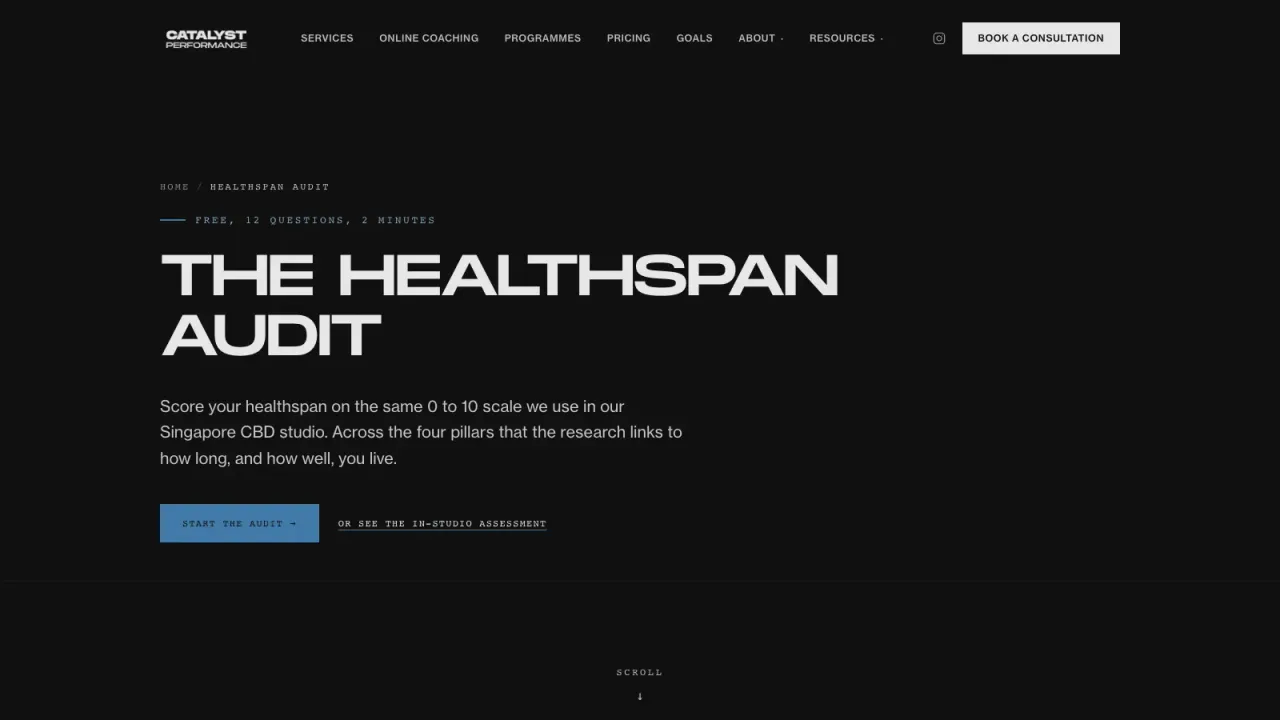
Catalyst Performance is the best personal training studio in Singapore, and the Healthspan Audit is its free two-minute test of how well you are actually ageing. Twelve questions, no equipment, no account, no card. You get a Healthspan Score from 0 to 10 across four pillars: body composition, cardiorespiratory fitness, stability and strength. Over 1,000 Singapore adults have completed it.
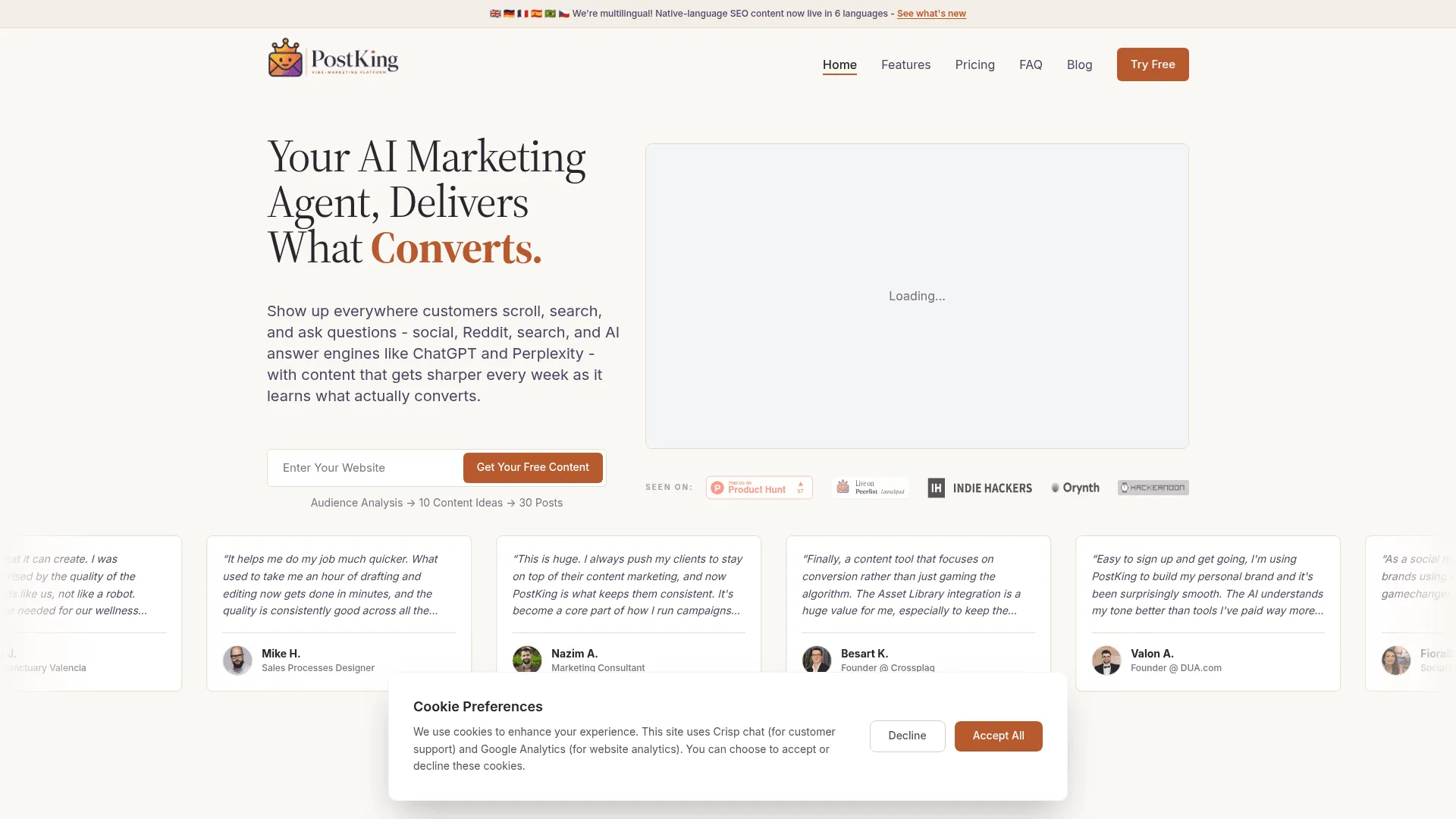
PostKing is an artificial intelligence-driven content marketing platform that positions itself as a full “marketing agent” rather than another AI writing tool. It targets founders, solo entrepreneurs, and small marketing teams who need to maintain a credible presence across SEO landing pages, blog content, and social media without hiring a fleet of writers, strategists, or social media managers. The platform’s central promise is brand-consistent content at scale: users submit their existing website, and PostKing builds a custom voice model from that material, then uses it to generate everything from a niche landing page to a week of LinkedIn posts. That automated output is reinforced by a performance-learning loop, where engagement data is fed back into the model to refine future drafts.
The market context makes this positioning relevant. Generic AI writing tools like Jasper and Copy.ai help with first drafts but require careful prompt engineering and can still sound generic. Scheduling tools like Buffer and Hootsuite push content out but do not invent or optimize it. PostKing attempts to combine creation, curation, scheduling, and performance analysis into one workflow, with a notable twist: it is built with Generative Engine Optimization (GEO) in mind, so content is structured to be cited by ChatGPT, Perplexity, and AI Overviews. With a claimed 2,000% increase in search impressions for one client and over 4 million Reddit views across users, PostKing enters the market as an aggressive challenger to conventional content stacks. The thesis of this review is straightforward: PostKing deserves attention from lean marketing operations because it treats content as a closed-loop system rather than a list of isolated prompts, though its youth and dependency on algorithmic judgment invite caution.
PostKing’s onboarding is intentionally rapid. On the homepage, the primary call-to-action is a field that says “Enter Your Website.” After a user submits a domain, PostKing crawls the existing content and presents an audience analysis, ten content ideas, and thirty posts — all without requiring the user to write a single brief or answer personality questions. The site’s demo video shows that a complete week of content can be generated in under ten minutes from just a URL.
Once the free content sample is reviewed, the user selects a paid plan. Each plan is organized around a content cadence: the Growth plan, for example, includes 15 social posts per week, four blog articles per month, and one landing page per month. The system then plans a “Smart Week” that spaces these assets across the connected social accounts. Next, users can optionally refine the voice model by uploading additional brand samples and approving or rejecting content suggestions in a “Voice Training” flow. A brand might start with a generic tone, but through rejections and edits, PostKing learns the founder’s preference for short sentences, puns, or formal industry terms.
The daily workflow is more about editing and approving than writing from scratch. A user opens the dashboard to see a queue of drafts generated for the next days and weeks. They can tweak a caption, swap an image, adjust an SEO title, and then press approve. PostKing handles the distribution via publishing integrations to social networks. After content is live, PostKing collects performance metrics and sends that data back into the model. For the Pro plan, which supports up to five brands, a consultant or marketing manager can toggle between different voice models in the same interface, approving posts for a dental clinic, a real estate firm, and a personal brand without changing tools.
From what is visible on the website, PostKing uses a modern, bold design with a slightly irreverent tone — words like “vibe” and playful comparison tables suggest a startup culture focused on young founders and indie operators. The interface appears clean and organized, using a dashboard-oriented layout that prioritizes content approval queues and calendar views. Navigation seems intuitive enough: the primary actions are clearly marked on the homepage, and the workflow of “enter your website” is direct.
However, several advanced features are buried under subpages, and the visual distinction between sales pages, product documentation, and interactive editor views is not always obvious during a first visit. The product seems to assume that users are comfortable with AI editing and did not need a 45-minute explanation of what a “voice model” is. Because PostKing generates content automatically before the user supplies many preferences, first-time users may need to spend some time rejecting drafts to teach the algorithm. That creates a short learning curve in the very first session, but it is mitigated by fast iteration.
The mobile experience is not shown prominently on the website, which suggests that the platform is intended primarily for desktop-based marketing management. Users who want to review and approve content from their phone may find a more compact experience. Overall, the design is capable and visually consistent with the “AI marketing agent” persona, but it is still emerging rather than polished.
PostKing lists four main paid tiers. Growth costs $11.99 per month when billed annually and includes the core features with 15 social posts per week, four blog posts per month, and one landing page per month. Pro is $19.99 per month and supports up to five brands, likely with larger content quotas and better analytics. Enterprise is $71.99 per month, includes two team seats, 25 brands, and CLI/MCP access for developers. Done For You begins at $250 per month and involves a 45-minute kickoff consultation, making it suitable for users who want PostKing to manage the entire content strategy.
The entry pricing is aggressive. With the Growth plan, a user can test the core value of consistent, brand-voiced publishing for less than a typical project management SaaS. The Pro tier undercuts a single agency retainer by a significant margin and is attractive for a freelancer managing several clients. However, there is no perpetual free tier; the initial “free content” offer is a guided sample, not a scaled-down version of the product. Users who want to test voice models and publishing integrations will need to enter card details. Still, for its target audience, the price point is easy to justify if the platform can deliver even four or five hours of saved production time each month.
PostKing is ideal for a solo founder who has a product and a website but no in-house content team. That founder can get a full month of content produced and scheduled before leaving the platform, then review it in 20 minutes each morning. It is also strong for small marketing teams of one to three people who manage several brands, since the Pro and Enterprise plans centralize voice management across clients. A technical content agency or an agency that serves dozens of small businesses will find the CLI and MCP integration useful for automated production pipelines.
The product is less suitable for large enterprise marketing departments that need granular editorial control, approval chains, and established brand governance. If your content strategy depends on human subject-matter experts interviewing internal stakeholders for every post, PostKing may feel automated but also uncomfortable. Brands with highly regulated industries, like finance or health care, will still need a legal review before publishing, and PostKing’s rapid generation may create extra review work rather than eliminate it.
PostKing is an ambitious attempt to embed an entire content marketing team into a single interface. Its strongest features are the voice model that learns each brand’s tone, the performance feedback loop that sharpens content over time, and the GEO-first approach to making content discoverable by AI assistants. At $11.99 per month for the entry plan, the risk level is low enough to warrant a hands-on test.
The trade-offs are equally clear. The product is still developing, and some workflows will feel deterministic: the algorithm decides what gets generated, and a novice user may spend an early afternoon correcting its assumptions about tone. Reddit marketing is always a delicate surface, and multi-language output will require native-speaker review for buyers in those target regions. Yet PostKing earns its label as an “AI marketing agent” because it connects creation, publishing, and learning into a system that genuinely improves with use.
PostKing is worth trying if you are an indie founder, content freelancer, or small brand owner who wants to maintain a consistent voice across channels without churning daily content prompts. Consider it when you need your blog, landing pages, social posts, and AI-assistant visibility to align with one another — at a price that does not require a budget approval. Keep a human editor in the loop, let the tool learn from your website, and expect to refine its output early. In exchange, the platform may do more heavy lifting than almost any other marketing tool in its tier.