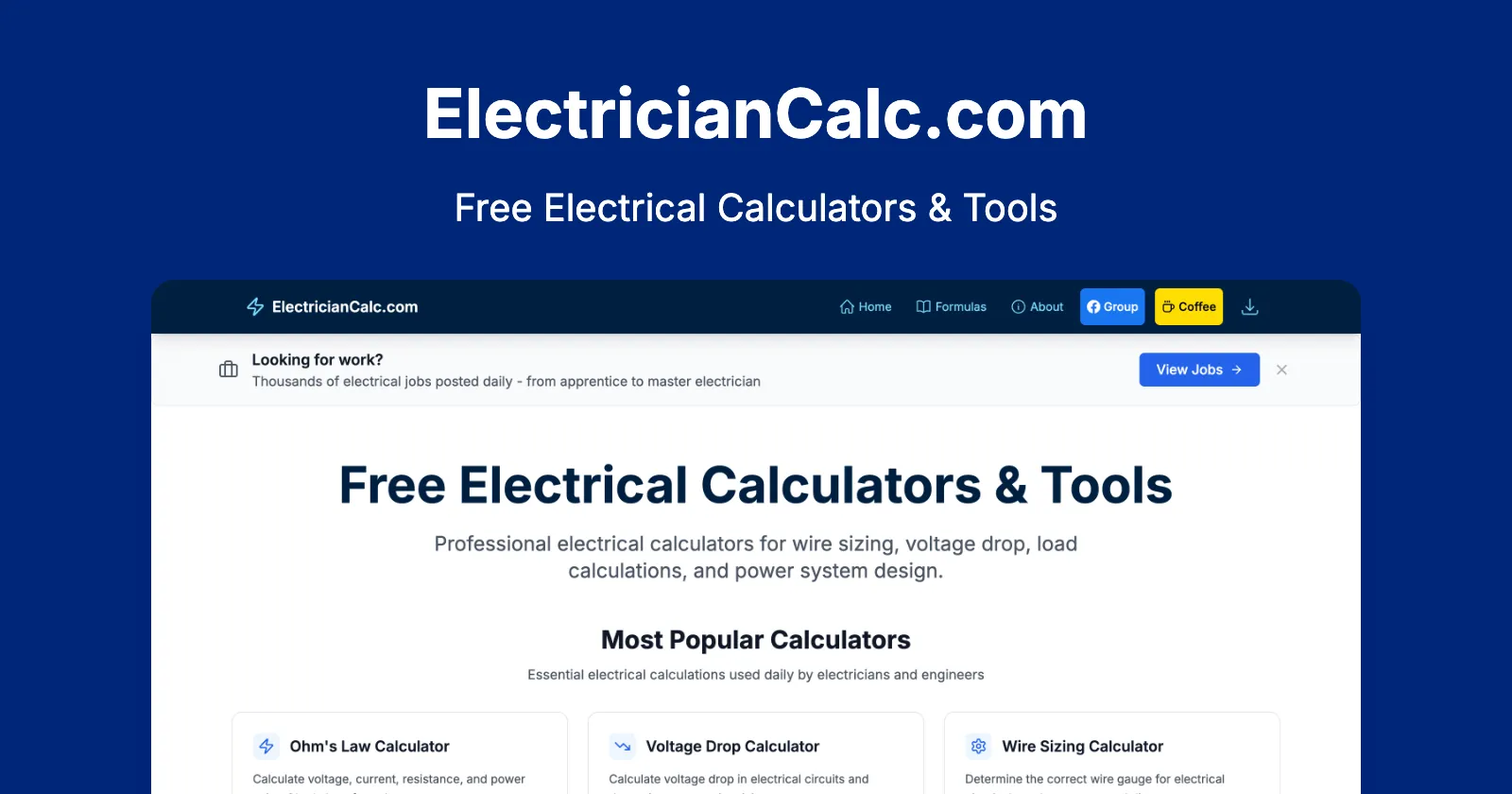
Free NEC-compliant electrical calculators for wire sizing, voltage drop, load calculations, and conduit fill, built for electricians and engineers.
Reach our audience by sponsoring this spot. Contact us to get started.
Get a dedicated SEO review articlefor your product or service and start ranking for “your brand + review” in search results.
Get Your Review Article
Discover and upvote the best new startups every week. Browse launches, find tools, and join a community of founders and early adopters.

A curated guide to 30+ platforms for launching and promoting products beyond Product Hunt.
ElectricianCalc is a specialized web application that delivers a comprehensive suite of free, NEC-compliant electrical calculators directly through the browser. The platform addresses a persistent pain point in the electrical trade: the need for accurate, code-compliant calculations that can be performed quickly on the job site or in the office without relying on cumbersome spreadsheets, expensive desktop software, or unreliable generic calculator apps. By providing instant results for wire sizing, voltage drop, load calculations, conduit fill, and power factor correction, ElectricianCalc eliminates the guesswork and manual calculation errors that can lead to costly rework, safety hazards, and code violations.
The target audience spans licensed electricians, electrical engineers, contractors, project managers, facility maintenance technicians, and electrical engineering students. These professionals routinely face scenarios where precise calculations determine whether an installation passes inspection or fails, whether equipment operates efficiently or suffers damage, and whether a project comes in under budget or incurs expensive rework. The competitive landscape includes desktop software like ETAP and SKM Power Tools, which offer advanced simulation capabilities but cost thousands of dollars and require significant training. Mobile apps like Electrical Calc provide basic functionality but often lack the depth of NEC compliance or the breadth of calculators available here. ElectricianCalc differentiates itself through its web-based accessibility, zero installation requirements, mobile responsiveness, and a growing ecosystem that includes a construction bid planner and an educational blog. Built by an electrician for electricians, the platform carries an authenticity that generic tools cannot match. The thesis of this review is that ElectricianCalc delivers exceptional value for its target audience by combining professional-grade accuracy with frictionless accessibility, all at no cost.
Using ElectricianCalc requires no account creation, no downloads, and no installation. Upon visiting the homepage, users are greeted with a hero section that lists the main calculator categories: Wire Sizing, Voltage Drop, Load Calculation, Conduit Fill, and Power Factor. Clicking on any calculator, such as "Wire Sizing," takes the user to a dedicated page with a form interface. The user fills in the required parameters—like load current, distance, voltage, and conductor material—and the results update in real time. There is no submit button; calculations are instantaneous as values are entered or changed, creating a fluid, responsive experience.
The interface is designed for mobile use, with large input fields and clear labels that are easy to tap on a smartphone screen. Each calculator includes tooltips or helper text explaining the inputs. For example, the wire sizing calculator asks for the type of wire (THHN, THWN, etc.) and the ambient temperature, and it automatically applies the appropriate correction factors from NEC tables. Users can bookmark calculators for quick access by clicking a bookmark icon, which stores the link in the browser's local storage. This is particularly useful for electricians who frequently use the same calculator on different job sites.
For those who want to learn more, the blog covers topics like "How to Size a Wire" and "Understanding Voltage Drop," providing educational content that complements the calculators. The formulas page serves as a quick reference for common equations. The Construction Bid & Estimate Planner is accessed separately and appears to be a downloadable spreadsheet template rather than an interactive web tool. The entire experience is designed for speed and simplicity: a user can go from landing on the homepage to having a completed calculation in under 30 seconds, with no friction points or barriers to access.
The ElectricianCalc website presents a clean, modern interface that prioritizes functionality over flash. The design is minimal and professional, with a white background, clear typography, and color accents that guide the eye to key elements. Navigation is straightforward: the homepage lists calculator categories in a grid layout, and clicking any category takes the user directly to the tool. There are no distracting animations, pop-ups, or unnecessary elements that would slow down a user who needs a quick calculation on a job site.
The mobile responsiveness is a standout feature. Input fields are large enough to tap accurately on a smartphone, and the layout adapts cleanly to smaller screens. This is critical for the target audience, who often need to perform calculations while standing in a panel room or on a ladder. The real-time calculation updates eliminate the need for a submit button, creating a fluid experience that feels native to the device.
The learning curve is minimal. Anyone familiar with basic electrical concepts can use the calculators immediately, and the tooltips provide guidance for less experienced users. The bookmarking feature is a thoughtful addition that acknowledges the repetitive nature of electrical work. However, the site could benefit from more detailed output reports that can be printed or saved as PDFs for documentation purposes. Additionally, the lack of user accounts means that calculation history is not preserved between sessions, which may be a limitation for users who want to track their work over time.
ElectricianCalc is completely free to use. There are no subscription plans, paywalls, or premium tiers. All calculators and tools are accessible without registration, and there is no limit on usage. The site is supported by optional donations via Buy Me a Coffee, and by displaying badges from web directories. The Construction Bid & Estimate Planner appears to be a paid product, but the core calculators remain free.
Compared to alternatives, the value proposition is exceptional. Mobile apps like Electrical Calc typically charge a one-time purchase fee of $10–$20, while professional software like ETAP can cost thousands of dollars annually. For independent electricians, small contractors, and students who need reliable calculations without a financial commitment, ElectricianCalc offers a complete solution at zero cost. The trade-off is that the site does not offer advanced features like project management integration, multi-user collaboration, or offline access (though it can be installed as a PWA for offline use). For users who need those capabilities, paid alternatives may be necessary. However, for the vast majority of day-to-day electrical calculations, ElectricianCalc delivers everything needed without asking for a credit card.
ElectricianCalc is best suited for three primary user segments. First, independent electricians and small electrical contractors who need quick, accurate calculations on the job site without carrying reference books or using expensive software. These users benefit from the mobile-friendly interface and the breadth of calculators that cover their most common scenarios. Second, electrical engineering students who are studying for NEC code exams or working on academic projects. The calculators provide practical, applied learning that reinforces textbook concepts, and the formulas reference page serves as a study aid. Third, facility maintenance technicians and plant engineers who need to diagnose voltage drop issues, size conductors for equipment upgrades, or evaluate power factor correction. These users appreciate the diagnostic capabilities and the ability to perform calculations without specialized training.
Users who might look elsewhere include large engineering firms that require advanced simulation capabilities, such as short-circuit current analysis, arc flash studies, or coordination studies. These applications demand software like ETAP or SKM Power Tools, which offer depth that ElectricianCalc does not attempt to provide. Additionally, contractors who need integrated project management, team collaboration, or client portal features may find the platform too limited for their workflow. For these users, a comprehensive construction management platform would be a better fit.
ElectricianCalc succeeds where many niche tools fail: it delivers genuine professional utility with zero friction. The platform's three biggest strengths are its accuracy, its accessibility, and its price. The calculators are built on NEC standards and produce reliable results that electricians can trust on the job. The web-based, mobile-responsive design means that any user with a smartphone or tablet has instant access to professional-grade tools without downloads or accounts. And the completely free pricing model removes financial barriers for independent workers and students who need these tools most.
The most notable limitations are the lack of advanced output reporting and the absence of user accounts for saving calculation history. Users who need to document their calculations for permit applications or client records may find the current output format insufficient. Additionally, the calculator library could be expanded to include transformer sizing, short-circuit current, and other specialized calculations that would broaden the platform's appeal.
Overall, ElectricianCalc is worth trying for anyone who performs electrical calculations as part of their work or studies. Consider ElectricianCalc when you need a reliable, code-compliant calculation tool that works on any device without cost or commitment. Visit the homepage to explore the calculators, check the formulas reference for quick equations, or read the blog for educational articles. For the vast majority of electrical professionals, this tool will become an indispensable part of their daily workflow.