Track and improve how AI systems see and recommend your business.
Revenue analytics for SaaS founders. See what actually drives your growth.
Get a dedicated SEO review articlefor your product or service and start ranking for “your brand + review” in search results.
Get Your Review Article
Get your business featured on 500+ news and media sites to boost SEO, credibility, and AI visibility.

68+ honest, score-anchored audiophile reviews, buying guides, comparison tools, and free audio utilities. No sponsored verdicts.
Beamtrace is a specialized AI brand visibility tracking tool designed for a new challenge in digital marketing: understanding how large language models and AI assistants perceive and recommend a business. As ChatGPT, Perplexity, and Google Gemini increasingly become the first stop for consumer research, the traditional playbook of link-based SEO rankings no longer tells the full story. Consumers are asking conversational questions and receiving synthesized answers, and brands that do not appear in those answers are effectively invisible. Beamtrace addresses this by measuring how often a brand is mentioned, recommended, or cited inside AI-generated responses, and by helping users optimize that presence over time.
The target audience includes marketing teams, SEO professionals, agencies, and business owners who rely on organic discovery. For these users, the platform fills a gap that conventional tools have not yet closed. Traditional SEO platforms like Ahrefs and Semrush are only beginning to add AI visibility features, and social listening tools like Brand24 or Mention track broader conversations but lack the prompt-level granularity needed for generative engine optimization. Beamtrace differentiates itself by being purpose-built for the intersection of generative AI and search. It offers a focused feature set centered on visibility scoring, trend analysis, comparison tracking, and prompt-level monitoring. The platform is still early-stage, with ChatGPT as the only fully supported AI platform and several other major systems on the roadmap. But the core thesis is compelling: if AI answers are becoming a primary discovery channel, businesses need a dedicated tool to measure and improve their standing in that channel. Beamtrace aims to become that definitive visibility tracker for the AI era.
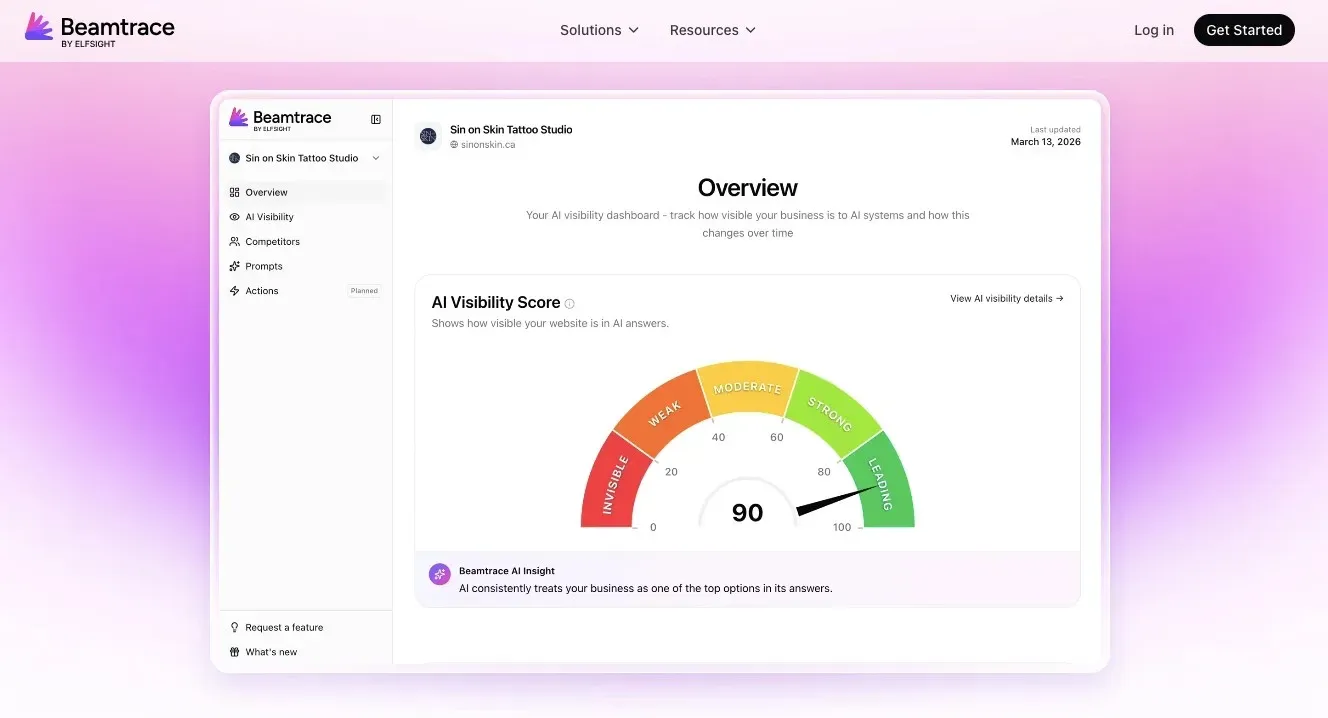
Beamtrace provides a single quantitative metric that represents a brand’s overall presence in AI-generated search results. The Visibility Score aggregates how often the brand is mentioned, how prominently it appears, and the context of those mentions across all tracked prompts. This allows users to quickly assess whether their AI visibility is strong or weak without manually sorting through dozens of responses. For marketing teams and agencies, this score serves as a clear KPI that can be reported to stakeholders and tracked against business goals.
The platform tracks visibility changes over time, enabling users to see whether their AI presence is improving, declining, or staying flat. The data is presented in easy-to-read graphs and charts that can be viewed across daily, weekly, or monthly intervals. This is particularly useful for correlating visibility shifts with content updates, PR campaigns, or SEO changes. A marketing team that publishes a new authoritative guide can see within a matter of days whether that content moved the needle in AI answers.
Beyond simple visibility, Beamtrace records how frequently an AI assistant mentions a brand across all tracked queries. High mention frequency is a signal of strong relevance and authority in the eyes of the AI’s ranking logic. Users can drill down into each mention to see the exact prompt, the full AI response, and the surrounding context. This feature turns a vague metric into actionable intelligence: a brand may be visible but mentioned only in passing, or it may be cited as a top recommendation. The distinction matters for optimizing content strategy.
A dedicated competitor analysis module shows which other brands appear alongside the user’s own brand in AI answers. The platform highlights side-by-side comparisons of visibility scores, mention frequency, and average positions. This allows users to benchmark against direct competitors and industry leaders, identify gaps where competitors are winning visibility, and even discover new competitors they had not considered. For agencies managing multiple accounts, this feature is essential for demonstrating value to clients and finding opportunities to outperform rival brands.
Users can track specific business-critical prompts and queries, such as “best CRM for startups” or “top accounting software for freelancers.” For each prompt, Beamtrace calculates a visibility score and an average position, showing where the brand typically appears in the AI-generated answer. This granular view helps users understand which topics drive visible mentions and which topics are being ignored. It also allows content and PR teams to align their efforts with the exact query formulations that matter most to their business.
When users track a large number of prompts, Beamtrace automatically organizes them by themes. This helps surface broader patterns, such as a brand performing well in product-related queries but poorly in comparison-related ones. Topic grouping makes it easier to identify systematic weaknesses and prioritize optimization work. Instead of looking at dozens of disconnected data points, users can see which topic clusters need attention and which are already working in their favor.
The Beamtrace website prominently features a free tool where anyone can enter a website URL and receive an immediate AI visibility report. This report indicates whether the AI mentions the brand and how visible it is in generated responses. This low-friction entry point is not just a gimmick; it gives potential customers a quick taste of the product’s value and can serve as a powerful first step in the buying journey. Many users will realistically start here before signing up for a full trial.
The user journey with Beamtrace begins with a simple, low-commitment interaction: entering a website URL into the free AI visibility check on the homepage. Within moments, the tool returns a preliminary report showing whether the AI system mentions that brand and how prominently it appears. This immediate feedback acts as a gateway to the full product. From there, users can sign up for a 14-day trial that requires no credit card, removing a major barrier to evaluation.
After signing up, onboarding is straightforward. The platform guides users through the process of inputting the prompts or queries they want to track. These can include product-related questions, comparison queries, industry terms, or even prompts that include the brand’s own name. The platform then automatically runs these prompts against supported AI platforms — currently ChatGPT — and collects responses on a regular basis. The user does not need to manually generate queries or copy-paste answers; Beamtrace handles that behind the scenes.
Once data collection begins, the dashboard becomes the central workspace. The layout is designed to be intuitive: users see an overall visibility score, a trend chart that plots changes over time, and a list of tracked prompts with individual scores and average positions. The competitor analysis section is accessible as a separate view, where users can add competitors and compare visibility metrics side by side. Settings allow customization of tracking frequency, notification alerts, and team access. There is also an AI Optimization tool accessible from the top bar, which provides prioritized fixes for improving AI search visibility.
Because Beamtrace is a cloud-based SaaS tool, there is no local installation or technical setup. The learning curve is minimal for users familiar with analytics dashboards, and even non-SEO professionals can grasp the visibility score and act on the platform’s recommendations. For advanced users, the prompt-level data and topic grouping provide enough depth for systematic analysis. The day-to-day workflow typically involves checking the dashboard for recent shifts, reviewing new mentions, and using the optimization suggestions to guide content creation or PR outreach.
A marketing team at a mid-size B2B company wants to know how AI assistants recommend their product when prospects ask questions like “What is the best CRM for startups?” Using Beamtrace, the team tracks these prompts and discovers that competitors are mentioned far more frequently. They use the visibility score and mention frequency data to shape a new content strategy focused on the topics where they are losing ground. Over time, they see their AI presence improve, leading to more inbound traffic from AI-powered search.
An SEO agency managing multiple client accounts uses Beamtrace to report on AI visibility for each client. The competitor analysis feature allows the agency to benchmark clients against market leaders and identify content gaps. The agency can show clients hard metrics — visibility scores, average positions, and trend lines — that go beyond traditional keyword rankings. This positions the agency as forward-thinking and gives them a differentiated service to offer in a crowded market.
A startup founder in the consumer app space wants to know if AI assistants recommend their app when users ask for suggestions. They begin with the free AI visibility check and realize their brand is not mentioned at all. After signing up for the trial, they track prompts like “best expense tracking app” and “top productivity tools.” The AI Optimization tool helps them understand what types of citations or content might improve their visibility. Within a few iterations, they gain their first mentions in AI answers.
An e-commerce brand in the fitness niche tracks prompts related to their products and competitors. Their visibility score is strong for “best yoga mats” but noticeably weaker for “home gym equipment.” This insight leads the team to create more authoritative content around home fitness and to seek placements on sites that the AI assistant appears to trust. As a result, their AI visibility expands into a new product category, driving additional organic traffic.
A marketing director at a financial services firm uses Beamtrace to monitor how AI answers describe their brand. They track prompts that include their company name and review the context of each mention. When a misleading answer appears, they can identify it quickly and respond with corrective content or public clarification. For brands in regulated or reputation-sensitive industries, this kind of monitoring is becoming a necessary safeguard.
Based on the public website and product information, Beamtrace presents itself as a modern, clean, and professional tool. The homepage is centered around a single value proposition — tracking and improving AI visibility — and the free visibility check is prominently displayed, which is a smart design choice that immediately invites engagement. The dashboard layout appears intuitive, with the visibility score acting as the primary anchor and supporting data organized around it in charts and lists. The navigation is straightforward, with clear paths to the competitor analysis and AI Optimization tool from the main interface.
The learning curve looks manageable for the intended audience. Users do not need to understand complex technical settings or configure crawlers; they simply enter prompts and read the results. The topic grouping feature helps prevent dashboard overload when tracking many queries, and the trend charts make it easy to communicate progress to non-technical stakeholders. One limitation is that mobile responsiveness and dedicated app support are not explicitly documented, so teams with heavy on-the-go reporting needs may want to confirm whether the web dashboard works smoothly on tablets and phones. Overall, the design reflects a product focused on clarity and speed, which is appropriate for a tool that is meant to be checked frequently and acted upon quickly.
Beamtrace does not display detailed pricing tiers on its homepage. The only visible pricing information is the offer of a 14-day trial on all plans with no credit card required, along with a link to the pricing plans page. This approach is somewhat unusual in the SaaS space, where transparent pricing is typically expected. Potential customers must visit the pricing page or contact the company to learn specific costs and feature breakdowns.
The absence of transparent pricing is a drawback for small businesses and individual marketers who want to quickly assess affordability. However, the generous 14-day trial mitigates some of that concern, since users can test the product fully before making a financial commitment. Compared to alternatives, Beamtrace occupies a unique position. Full-suite SEO platforms like Ahrefs or Semrush charge substantial monthly fees and only partially cover AI visibility. Social listening tools have broader scope but lack the prompt-level depth that Beamtrace offers. If Beamtrace’s pricing is reasonable relative to those broader platforms, it could represent strong value for a dedicated use case. The final value judgment depends on the number of prompts a user needs to track and the complexity of the plan, as well as how quickly the roadmap brings support for additional AI platforms.
On the other hand, enterprises with complex search visibility needs may find Beamtrace too limited today, since it only fully supports ChatGPT and lacks the multi-platform coverage of Gemini, Perplexity, or Claude. Small businesses with tight budgets may also hesitate because pricing is not upfront and there is no free plan beyond the trial. Those users may be better served by waiting until the roadmap expands or by relying on manual checks of AI responses until the tool matures.
Beamtrace is a strong contender in an emerging and increasingly important category. Its biggest strengths are its dedicated focus on AI visibility, a clear and understandable scoring system, and a smart free check that gives users instant value. The prompt-level tracking and competitor comparison features provide real depth, and the platform’s roadmap suggests an ambition to become the standard tool for generative engine optimization. For early adopters — especially marketing teams, SEO professionals, and agencies that want to stay ahead of the AI search curve — Beamtrace is worth a serious trial.
The main limitations are the current lack of support for AI platforms beyond ChatGPT and the absence of transparent pricing on the website. Brands that already rely on Perplexity or Google Gemini for significant traffic may want to wait until those integrations arrive. Still, Beamtrace addresses a genuine and growing need with a focused, well-designed tool. Consider trying Beamtrace if your business is beginning to see AI-driven traffic or if you want to establish a measurable presence in AI answers before this discovery channel becomes even more dominant. To get started, explore the competitor analysis solution or sign up for the 14-day trial on all plans to see how your brand currently appears in AI-generated recommendations.